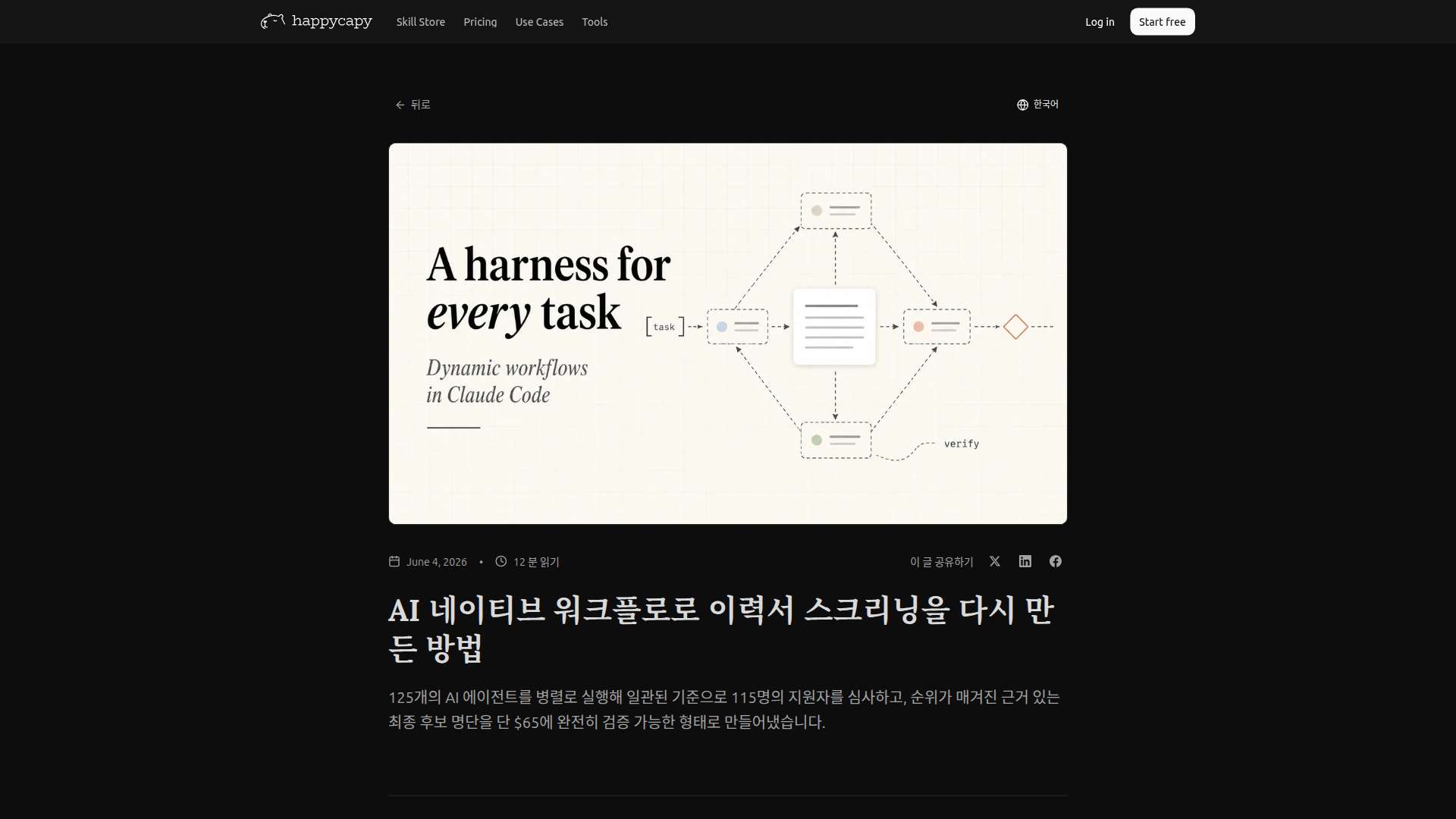
In the global tech landscape, the way artificial intelligence is applied to practical tasks is evolving rapidly beyond one-off prompt conversations into workflow-driven orchestration of multiple agents. While past practices centered on typing queries into chat interfaces and waiting for individual text generation, the new standard involves controlling complex business processes entirely through code, allowing dozens or hundreds of AI agents to collaborate in parallel. At the forefront of this paradigm shift is HappyCapy. HappyCapy is a next-generation agent-native computer platform that provides a secure sandbox environment within the browser, enabling users to delegate complex tasks to AI agents leveraging diverse models and skills.
The innovation embedded in this platform was recently demonstrated through a real-world hiring automation case study. The operations team integrated a Notion hiring database with Claude Code, establishing a dynamic workflow that executed over 100 AI agents simultaneously. Through this setup, 115 applicant resumes were reviewed according to consistent criteria in just 13 minutes, producing a fully verifiable shortlisted candidate roster at a remarkably low cost of 65 dollars. Tasks that traditionally required dozens of hours of manual human labor were completely transformed through the organic collaboration of an agent collective.
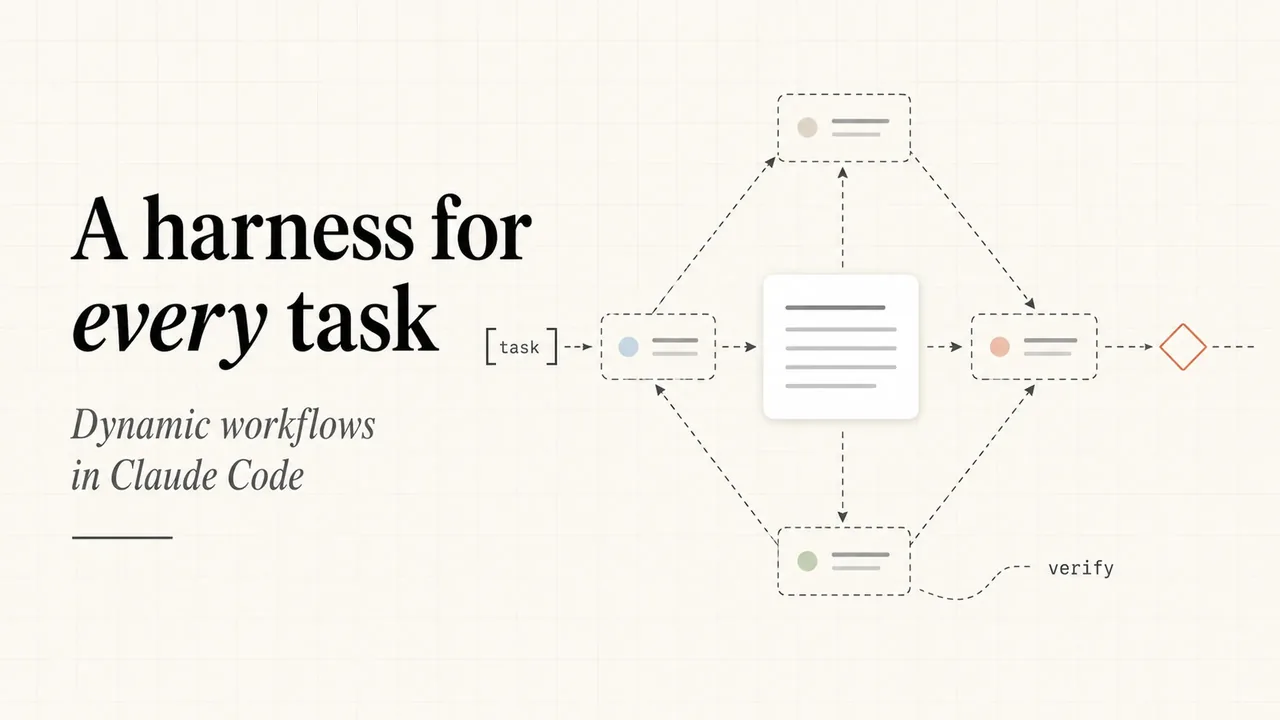
The fundamental reason behind this achievement lies in HappyCapy's unique architectural design. Conventional systems often suffered from noise accumulation and degraded evaluation standards as a single agent attempted to process every step sequentially. In contrast, HappyCapy completely separates deterministic control flow from the subjective judgment of AI. Loops, data distribution, aggregation, and quota enforcement are handled directly by code, ensuring reproducibility and auditability. Meanwhile, qualitative evaluations—such as determining whether a candidate's background is sufficiently strong—are delegated to distributed AI agents.
Furthermore, by utilizing fan-out parallelism, a multitude of independent agents can be spun up simultaneously with a single call, allowing each agent to process its assigned share without cross-contamination. The output returned by each agent is not ambiguous free-form text, but rather structured data adhering to strict JSON schemas. This enables subsequent processes like filtering, ranking, and deduplication to be reliably executed through code, yielding trustworthy final outputs.
This multi-stage pipeline architecture extends far beyond resume screening. It can be immediately applied to a wide array of business domains that are too vast for manual processing and too noisy for a single agent, such as large-scale content analysis, hiring panel simulation, and massive cross-validation of data. HappyCapy's Skill Store serves as a hub where users can easily discover and apply these advanced workflow templates and skills, offering optimal tools for both developers and business operators.

From a corporate management perspective, adopting such an agent-native platform creates immense business value across three core pillars: autonomous monetization, operating cost reduction, and productivity innovation. First, regarding autonomous monetization, HappyCapy's agent-native computer platform expands new revenue opportunities by automating complex business workflows. The recent case study of executing 125 AI agents in parallel to screen resumes in 13 minutes for 65 dollars can be immediately expanded into high-value consulting and screening services such as large-scale sales lead scoring, partner proposal reviews, and automated market research report generation. This enables companies to multiply their bidding capacity without personnel constraints, achieving an estimated annual revenue increase of 1.5 million dollars. However, to solidify monetization, subscription-based billing models combining continuous monitoring with post-management must be refined, alongside legal responsibility guidelines for agent-derived outputs.
Second, regarding operating cost reduction, the implementation of this system drastically cuts operational expenditures by completely replacing repetitive, mundane administrative tasks that previously demanded massive human resources and time. Reviewing 115 applicants manually requires at least three recruiters working across multiple days, whereas the multi-stage pipeline architecture and fan-out parallelism accomplish this in just 13 minutes, reducing labor and management costs by over 70 percent. As proven in this hiring screening automation case, replacing thousands of dollars worth of professional labor with a mere 65 dollars in computing costs maximizes the cost-benefit ratio. Nevertheless, to minimize trial-and-error costs during initial system integration and prompt optimization, sandbox configuration manuals aligned with internal data security standards must be enhanced, alongside exception-handling algorithms that automatically capture human supervisor intervention points.
Third, regarding 10x productivity innovation, HappyCapy fundamentally resolves the noise and hallucination issues inherent in single agents by perfectly separating deterministic control flow from subjective AI judgment while guaranteeing structured JSON schema outputs. The fan-out architecture, where dozens to hundreds of independent agents operate in parallel without mutual contamination, drives a 30-fold increase in processing speed and 99 percent adherence to consistent evaluation criteria compared to manual work. This presents an innovative programming paradigm that completely overcomes human cognitive limits in complex large-scale data cross-validation and multifaceted evaluation simulations. To further optimize automation, future technical enhancements should focus on reducing redundant computations during cross-validation among agents and introducing caching mechanisms to simultaneously optimize API call costs and processing latency.

In conclusion, HappyCapy transcends the limitations of simple chatbot wrappers or basic retrieval-augmented generation systems, establishing a unique technological moat as a true agent-native computer platform that orchestrates multiple agents within a secure browser sandbox. It demonstrates exceptional completion quality by fully replacing manual administrative tasks to revolutionize corporate cost structures and maximize productivity. For those looking to automate complex repetitive work and direct AI agent collectives to make consistent, objective decisions with minimal human effort, this platform offers the most powerful and cost-effective solution. Visit
https://happycapy.ai/ko/blog/hiring-dynamic-workflow right now to directly experience the workplace innovation brought by agent-native workflows.