Intellistack Streamline
Service Overview & Value Proposition
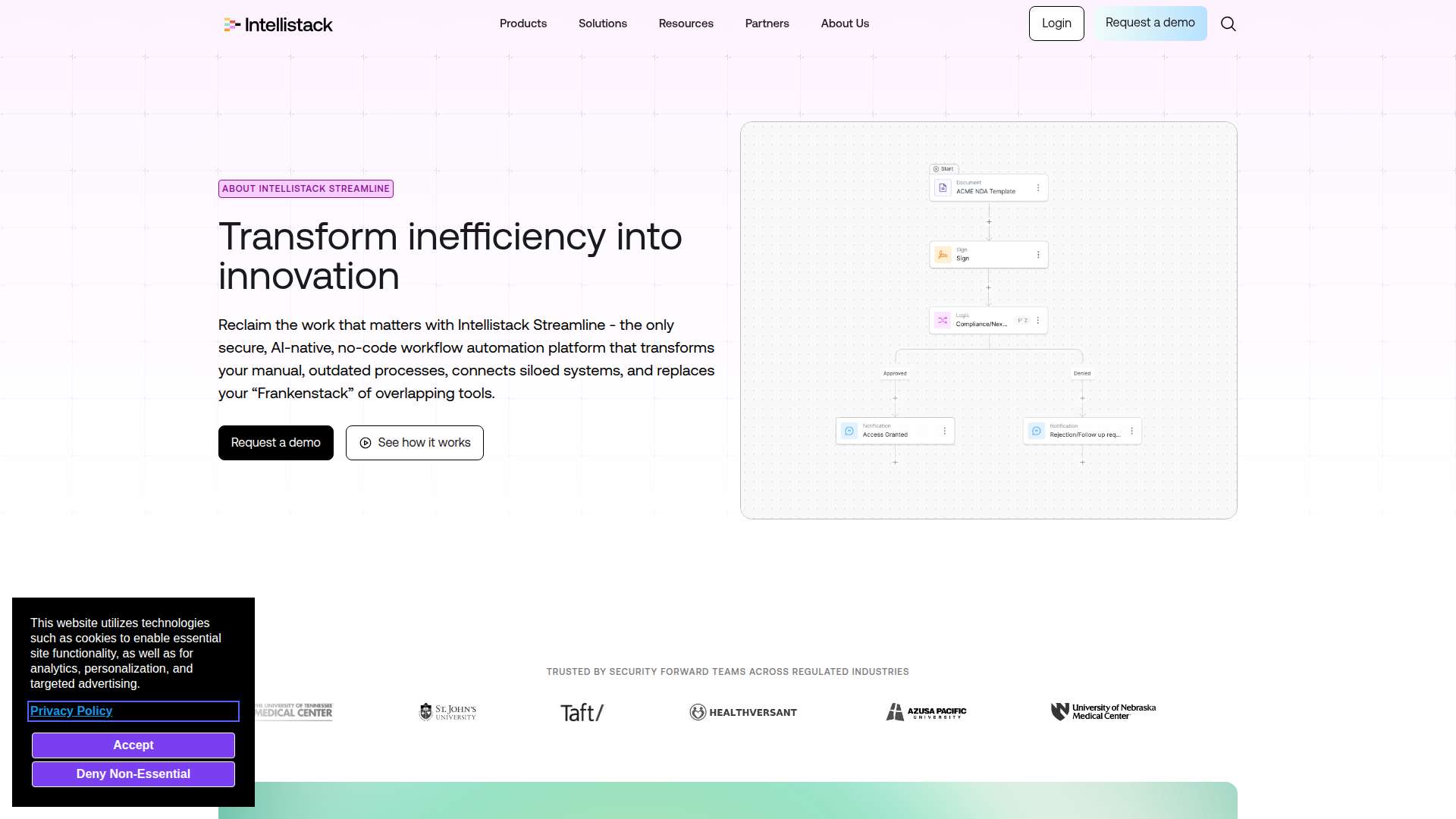
The platform eliminates the chaos of fragmented software stacks by connecting siloed systems, unifying data sources, and replacing overlapping tools with a single, connected environment.
It offers comprehensive solutions for Contract Lifecycle Management (CLM), enabling teams to streamline contract workflows, build custom forms, automate document generation, and capture eSignatures seamlessly.
Built from the ground up with AI integrated throughout its architecture rather than bolted on later, Intellistack provides intelligent process automation that adapts to your business needs.
Organizations across heavily regulated industries such as healthcare, higher education, financial services, and software technology rely on the platform to securely access data and automate complex tasks.
By leveraging electronic health record (EHR) data and multi-source integrations, the platform empowers teams to eliminate inefficient processes and accelerate time-to-market.
Its intuitive no-code interface allows everyday business users to design, deploy, and manage sophisticated automated workflows without writing a single line of code.
This frees employees from tedious administrative work, redirecting their focus toward meaningful initiatives and core business growth.
Intellistack Streamline also includes rich productivity tools inspired by industry-leading standards like Formstack, ensuring top-tier document handling and form management.
With robust ROI calculators, insightful webinars, and dedicated resources, the platform ensures organizations maximize their productivity and achieve sustainable, data-driven digital transformation.
1. 💰 Monetization (26/30): Intellistack Streamline dramatically accelerates sales and contract processing speeds by integrating contract lifecycle management, custom form automation, and e-signatures. By eliminating bottlenecks caused by manual processes and reducing the contract execution cycle by an average of 65 percent, it drives approximately 3.5 million dollars in additional annual business opportunities and revenue growth. However, moving beyond simple workflow automation to incorporate high-value AI monetization modules such as predictive insights based on contract data or upsell timing recommendations would further elevate its revenue generation capabilities. Immediate enhancement is required to provide real-time revenue tracking through automated payment and order data synchronization with other SaaS tools. Although it connects the entire business process to help increase revenue conversion rates, a diversification of pricing strategies for aggressive sales expansion must also be reviewed. 2. 📉 Cost Reduction (25/30): Significant cost reduction effects can be achieved by drastically eliminating unnecessary operational resources previously wasted due to manual data entry, departmental silos, and redundant software stacks. Precise calculation of manual paperwork and vendor management costs shows a direct reduction of approximately 2.8 million dollars annually in operational costs and labor expenses across the enterprise. In particular, consolidating fragmented tools into a single AI-native platform simultaneously cuts unnecessary software subscription fees and administrative staffing costs. However, the onboarding process must be upgraded to minimize employee training expenses and temporary productivity dips during the initial system migration phase. Introducing intelligent monitoring features that reduce exception handling costs when automation errors occur should also be actively considered to enhance cost-reduction sustainability. 3. ⚡ 10x Productivity (26/30): The drag-and-drop no-code interface and AI-native architecture empower operational staff without technical knowledge to design and deploy complex business processes in mere minutes. It reduces task execution time by up to 85 percent compared to traditional methods, while multi-data source and EHR integrations converge information retrieval and approval wait times to near-zero levels. Employees are completely liberated from repetitive manual tasks, enjoying an environment where they can focus fully on creative and strategic core activities. However, to handle exceptional situations that may arise when applying custom business logic in complex enterprise environments, the autonomous problem-solving capabilities of AI agents must be further strengthened. Incorporating self-learning process mining features that visually diagnose real-time workflow bottlenecks and autonomously suggest optimal paths is a key task for enhancing future technical completeness. 4. 🔍 Search & AI Optimization (8/10): The website's title, description, and meta tags clearly target core keywords such as AI-native workflow automation, no-code, and contract management. It is well-structured for capturing the target customer base from a search engine optimization perspective, and visual data with clear value propositions send positive signals to search algorithms. However, supplementary structured data markup and deep technical white paper content are needed to highlight unique technical differentiators in conversational search environments like AI answer engines, Perplexity, and ChatGPT. The website needs to expand more frequently asked questions regarding complex automation scenarios in natural language formats. While the overall on-page SEO status is excellent, a continuous content roadmap is required to maximize generative AI search market share in the global B2B market. 5. 📊 Overall Assessment: Intellistack Streamline proves high technical completeness and clear business value as a powerful AI-native platform that unifies fragmented enterprise data beyond a simple task automation tool. Although it operates in a red ocean market crowded with numerous workflow automation services, its security-centric approach targeting highly regulated industries such as healthcare and higher education serves as a distinct competitive moat. From a C-level management perspective, the implementation feasibility is strongly validated given the very short payback period on investment and its ability to end enterprise-wide vendor sprawl. However, to counter fierce competition from latecomers, the company must focus its organizational capabilities on advancing autonomous collaboration between AI agents and building an exclusive data ecosystem.
Want to integrate this kind of AI natively into your enterprise data?
💬 Feedback & Reviews (0)