Law ChatGPT
Service Overview & Value Proposition
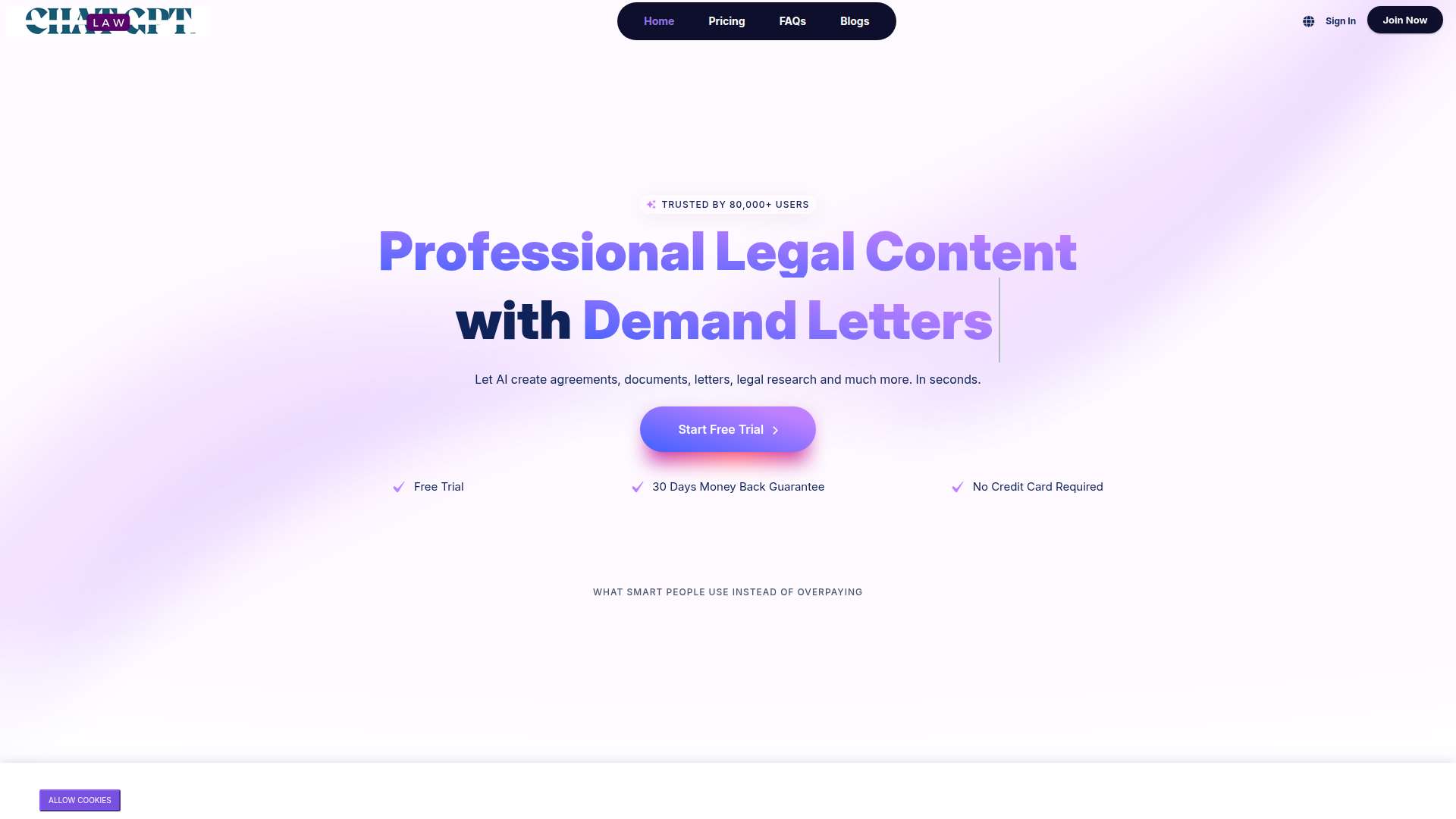
Instead of going through complex and costly traditional legal advisory processes, users can quickly and accurately create various customized legal documents—such as Non-Disclosure Agreements (NDAs), employment contracts, Powers of Attorney (POAs), service agreements, promissory notes, and website privacy policies—with simple inputs and clicks.
This platform supports the entire process from cumbersome legal research and detailed contract clause configuration to the generation of customized negotiation outlines, dramatically reducing legal costs and maximizing work efficiency.
It provides practical solutions that help individuals lacking legal knowledge, startup founders, and in-house legal teams establish reliable legal safety nets without incurring exorbitant fees.
With a 30-day money-back guarantee and a free trial requiring no credit card, anyone can easily test and experience the platform's powerful document generation capabilities without any financial burden.
Trusted by tens of thousands of users, Law ChatGPT is the ultimate alternative for smart individuals seeking to avoid overpaying for legal services and handle their legal paperwork in the fastest, safest way possible.
By easing the burden of drafting complex legal phrasing through the one-shot agreement creator and custom clause setting features, anyone can effortlessly complete professional-grade legal content.
1. 💰 Monetization (18/30): The Law ChatGPT platform has the potential to generate 4.5 million dollars in new digital subscription revenue annually through automated legal document generation such as standard contracts, NDAs, and POAs. The structure of securing stable recurring revenue via pay-per-document or SaaS subscription models is highly intuitive and efficient from a business perspective. However, it exists in a critical red ocean limitation where numerous legal tech startups and similar template-based automation services already flood the market, making it difficult to secure a unique moat. To maximize revenue, the platform must actively integrate dynamic update features that reflect real-time legal changes and paid add-on services for custom risk analysis reports beyond simple template filling. 2. 📉 Cost Reduction (16/30): It is analyzed that corporate legal teams and small businesses can significantly reduce high advisory fees and review labor costs previously paid to external law firms, saving approximately 3.2 million dollars in financial expenses annually. It dramatically reduces the resources of internal personnel spent on simple contract drafting and review processes, creating an environment to focus on core business capabilities. However, considering the legal liability and risk costs of errors, final review by a lawyer is still essential rather than complete unmanned automation, so the actual labor cost reduction may be somewhat lower than expected. Therefore, to maximize cost reduction, the system must upgrade its anti-hallucination filtering system to verify the accuracy of AI-generated documents and supplement risk management systems such as error guarantee insurance integration. 3. ⚡ 10x Productivity (18/30): It completes contract drafting and review tasks that previously took 3 to 5 days on average in just a few seconds, providing a dramatic productivity improvement of over 10 times in terms of processing speed. One-shot contract creators and custom clause setting features minimize the user's manual input steps, drastically shortening the document creation workflow. However, for complex and special legal disputes or large-scale contracts intertwined with multi-party interests, the output of a single-agent-based generation alone is insufficient for practical application, making additional manual edits inevitable. For technological advancement, a transition to a multi-agent orchestration architecture where multiple agents cross-verify complex contract structures and simulate negotiation scenarios is urgently needed. 4. 🔍 Search & AI Optimization (6/10): The website's basic title and meta tags appropriately include core keywords related to legal AI and contract creation, showing a solid level from a traditional search engine optimization perspective. Structured HTML markup and clear service introduction phrases contribute to increasing the indexing efficiency of public search crawlers. However, in next-generation AI answer engine environments such as ChatGPT or Perplexity, semantic structured data and knowledge graph integrations that can be directly cited when users search for legal advice are somewhat lacking. To take the lead in the AI search era, the platform must expand its legal Q&A database and strengthen structured Schema.org markup to maximize the exposure ratio in generative AI recommended responses. 5. 📊 Overall Assessment: While the attempt to simplify the inefficiencies of the traditional legal document creation market with AI technology is positive, this service is a typical red ocean item with numerous powerful competitors already entrenched in the global legal tech market. If it fails to move beyond a simple ChatGPT wrapper, it will be difficult to maintain a long-term technological moat and face the risk of being marginalized in price competition. Management must significantly raise the platform's barrier to entry by pivoting beyond simple document generation into enterprise-customized compliance monitoring and real-time legal risk prediction solutions.
💬 Feedback & Reviews (0)