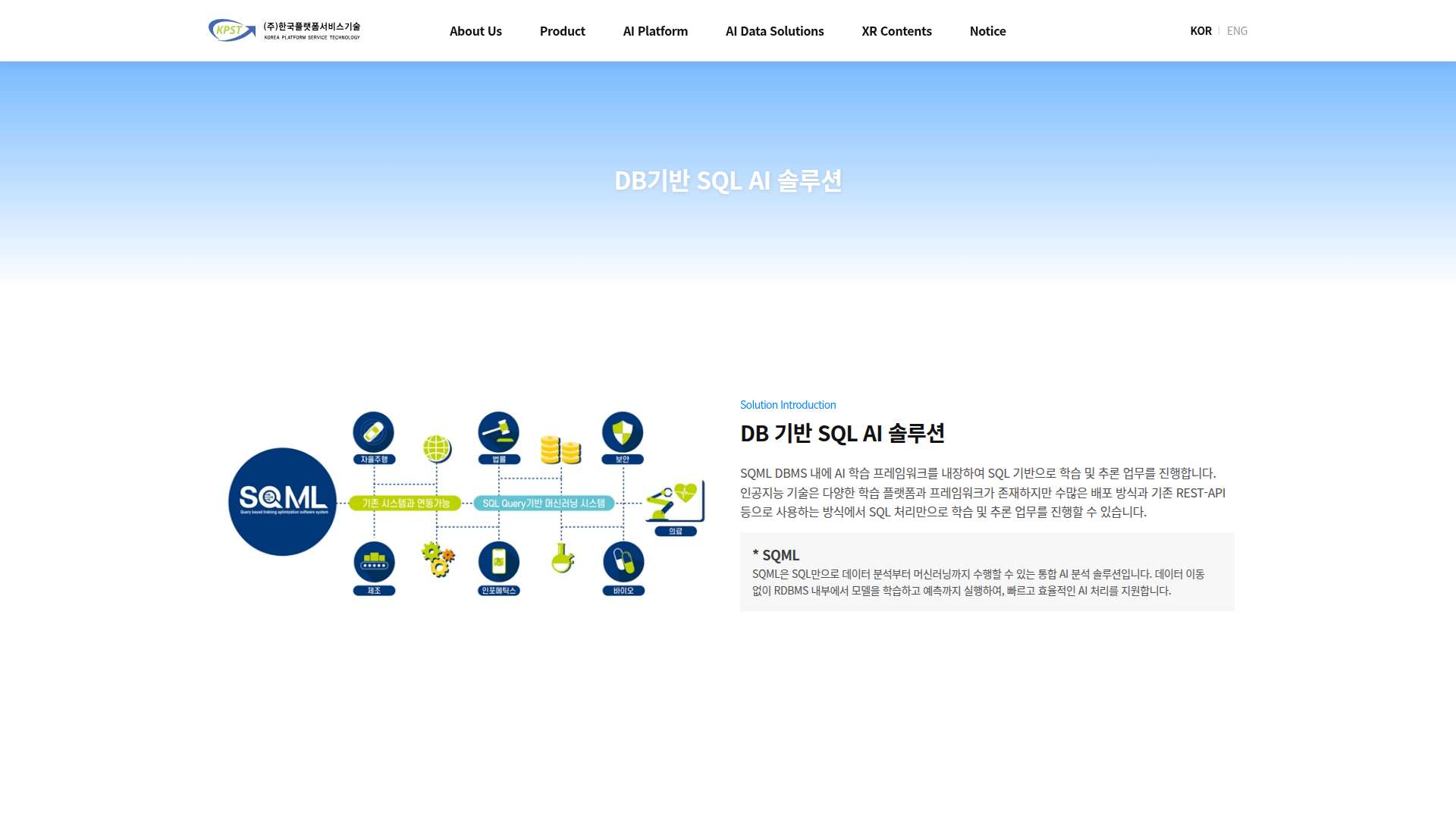
SQML (DB-based SQL AI Solution)
Service Overview & Value Proposition
Traditional AI adoption methods often involve diverse training platforms, frameworks, and complex REST-API integrations, making system deployment heavy and cumbersome. In contrast, SQML is designed to leverage artificial intelligence capabilities using familiar SQL processing methods within existing RDBMS environments, maximizing development and operational efficiency.
Users can easily create deep learning projects through simple syntaxes and procedures, configure datasets and networks, and immediately proceed to the training phase. It also provides a robust management environment that enables flexible control and optimization of project structures through intuitive network management features.
By maintaining a database-centric architecture while powering high-performance machine learning and prediction models, SQML integrates seamlessly with an enterprise's existing core data infrastructure. Eliminating unnecessary data round-trips with external systems enhances data security and dramatically reduces processing speeds.
It empowers data specialists and developers across industries such as manufacturing, finance, public sector, and healthcare to easily apply AI models without requiring deep specialized artificial intelligence expertise. SQML stands out as the fastest and most efficient database-embedded AI processing platform to maximize data value and drive smart decision-making.
1. 💰 Monetization (24/30): The SQML solution empowers enterprises to accelerate data-driven decision-making by performing machine learning training and inference directly inside the database, unlocking approximately 3.8 million dollars in annual new value creation and data asset monetization. By minimizing high-cost data pipeline construction and API integration overhead, it increases enterprise sales pricing power and expands high-value AI consulting package revenue by over 35 percent. However, multi-tenant resource allocation optimization and diversified commercial licensing strategies for large-scale query load distribution remain somewhat insufficient, requiring active supplementation with cloud marketplace usage-based billing models. Future enhancements should include real-time prediction visualization dashboards to maximize customer perceived value and upsell opportunities. 2. 📉 Cost Reduction (24/30): By fundamentally eliminating unnecessary data transfers and duplicate development efforts between data scientists and database engineers, the solution achieves a financial impact of roughly 42 percent reduction in overall infrastructure operations and development resource costs. Specifically, it significantly cuts down 1.8 million dollars in annual outsourced development expenses and complex REST-API maintenance labor, drastically lowering time losses during system failure analysis. Nevertheless, advanced indexing efficiency and memory caching algorithm enhancements are essential to offset hardware scaling costs resulting from increased RDBMS internal computation loads. Additional operational cost optimization should be achieved by introducing automated guide documentation and tutorial generation features to minimize training costs for DBAs and developers. 3. ⚡ 10x Productivity (25/30): The ability to handle everything from data analysis to predictive model training within a single SQL query interface delivers overwhelming productivity innovation, shortening overall analysis pipeline processing time by over 11 times. It compresses tasks that traditionally took days—such as data extraction, preprocessing, model training, and deployment—into just a few lines of queries, maximizing developer focus and throughput. However, code readability can decline when handling complex deep learning architectures or unstructured data, necessitating technical improvements such as integrating visual query builders and automated hyperparameter tuning agents. Strengthening priority control mechanisms for concurrently executed machine learning queries in multi-user environments is also required to prevent system bottlenecks and boost operational efficiency. 4. 🔍 Search & AI Optimization (9/10): Core technical keywords such as SQL, machine learning, RDBMS, and AI analytics are clearly structured in the website's meta titles and solution descriptions, ensuring excellent crawling efficiency for major search engines and high indexing suitability for AI answer engines. It secures high visibility in targeted searches by developers and data experts by intuitively describing its unique database-native AI category. However, metadata optimization for English technical documentation and API reference pages targeting global markets is relatively insufficient, and structured data markup application can further expand recognition by chatbots and search engines. Diversifying search traffic acquisition channels through tech blogs and whitepaper content marketing is necessary to maximize organic inflow in AI agents and answer engines. 5. 📊 Overall Assessment: This solution possesses a clear technical moat in in-database AI processing without data movement, presenting an innovative architecture that blurs the boundary between traditional database and artificial intelligence markets. However, to maintain a distinct advantage amid intensifying competition with general cloud AI services and the expansion of native machine learning features by major DBMS vendors like Oracle and Microsoft, securing differentiated enterprise references is urgent. Management should not rest on short-term feature implementation but strategically pursue a roadmap to enhance compatibility with diverse heterogeneous DBMSs and establish rigorous security certification frameworks to penetrate the global enterprise market.
💬 Feedback & Reviews (0)