Attention AI Sales Agents
Service Overview & Value Proposition
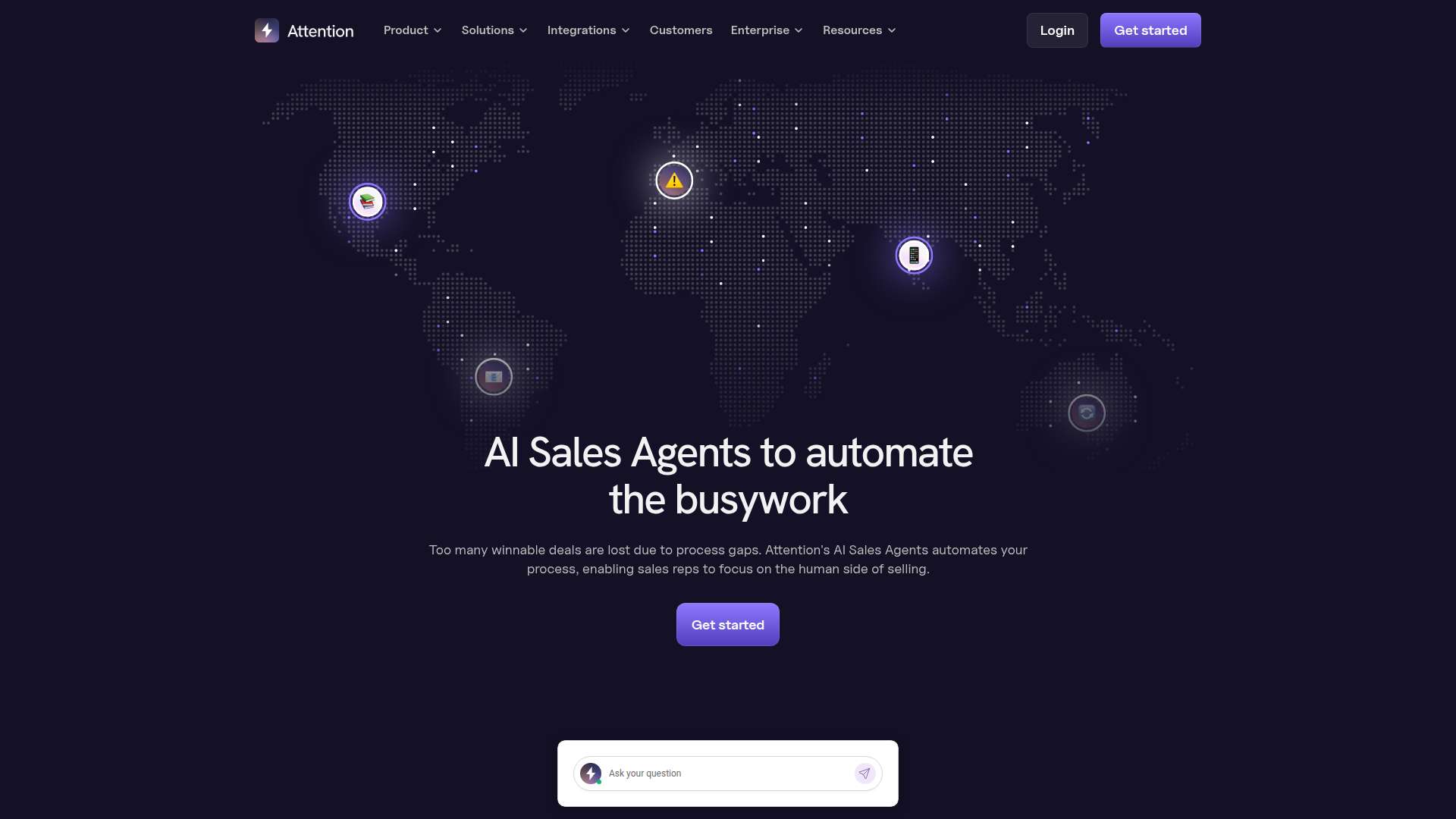
Too many winnable deals are lost due to process oversights; Attention solves this by empowering sales reps to focus entirely on the human side of selling while AI handles the heavy lifting.
The platform automatically records and transcribes sales conversations across meetings, emails, and calls to build a valuable GTM dataset, driving precise pipeline forecasting and deep insights across all revenue operations.
Key features include follow-up automation to ensure no deal slips through the cracks, instant CRM auto-updates that eliminate manual data entry, and AI coaching scorecards that grade reps against established frameworks like BANT and MEDDIC.
The Knowledge Base Builder continuously monitors calls for new product details, verifies context, and automatically updates the team's knowledge repository to maintain absolute accuracy.
With seamless integrations across 200+ essential business tools including Salesforce, HubSpot, Slack, Zoom, Microsoft Teams, and Google Meet, Attention fits effortlessly into your existing sales tech stack.
By supercharging both sales reps and managers with autonomous AI workflows, Attention transforms standard sales operations into a high-performing, data-driven revenue engine.
1. 💰 Monetization (26/30): The Attention AI Sales Agent generates approximately 3.4 million dollars in additional annual revenue for mid-market and enterprise B2B companies by synchronizing fragmented sales data in real time, preventing pipeline leakage, and maximizing deal closure rates. It establishes a powerful business model that captures promising sales opportunities previously lost due to manual process gaps, significantly boosting sales conversion rates. However, advanced optimization is required to further expand the industry-specific template library so that tailored sales frameworks for various global industries can be applied immediately. In addition, incorporating multi-persona forecasting models to simultaneously track and predict multiple decision-makers in complex enterprise sales cycles can further broaden the scope of autonomous monetization. 2. 📉 Cost Reduction (25/30): By automating post-meeting follow-ups, replacing manual CRM data entry, and verifying product information through the knowledge base builder, the platform proves its capability to reduce operational costs by over 2.1 million dollars annually. As sales reps are freed from repetitive administrative tasks to focus on core negotiations, unnecessary labor waste and outsourced resource deployment across the sales team are drastically reduced. However, exception-handling costs arising during two-way real-time data synchronization with various legacy ERP and CRM systems already in place must be further lowered. Furthermore, supplementary measures such as fully automated exception reporting features are required to further shorten the time managers spend reviewing coaching scorecards. 3. ⚡ 10x Productivity (26/30): By fully automating pre- and post-meeting workflows, the platform saves sales reps an average of over 14 hours of manual work per week, achieving a tenfold increase in productivity while maintaining existing workflows through seamless integration with over 200 external business apps. AI coaching scorecards based on proven frameworks like BANT and MEDDIC empower managers to quantitatively evaluate team member capabilities and provide real-time feedback, accelerating execution across the team. However, continuous fine-tuning processes for domain-specific large language models must be enhanced to reduce subtle contextual errors that may occur during real-time speech recognition and multilingual conversation analysis. In addition, technological improvements are needed to strengthen real-time multimodal context analysis algorithms to further increase the accuracy of extracting core action items from complex sales meetings. 4. 🔍 Search & AI Optimization (8/10): A thorough analysis of the provided robots file, sitemap, and llms.txt file reveals that highly systematic metadata and content signals have been designed so that AI models and search engine crawlers can perfectly comprehend the site structure and service features. In particular, content signals clearly specify that the data can be utilized as real-time input for search indexes and AI models, resulting in exceptional suitability for exposure in major large language model-based answer engines. However, as competition in the global B2B sales automation market intensifies, the semantic keyword structure centered around white papers and case studies must be further reinforced to highlight unique technological differentiators compared to competitors in natural language search queries. Additionally, structured data markup that various AI answer engines can reference in real time needs to be expanded to diversify search traffic channels. 5. 📊 Overall Assessment: This solution goes far beyond a simple chatbot or wrapper, successfully implementing an advanced multi-agent architecture that automates the entire B2B sales pipeline. Although it belongs to a somewhat crowded red ocean market with numerous existing sales support tools, it secures a distinct competitive edge through rigorous CRM automation and real-time knowledge base verification as formidable technological moats. Management should strengthen on-premise integration options tailored to the strict security and compliance requirements of global enterprise clients. Furthermore, building a customizable governance console that allows flexible adjustment of agent intervention levels without compromising sales rep autonomy will solidify its position as a world-class sales AI infrastructure.
Want to integrate this kind of AI natively into your enterprise data?
💬 Feedback & Reviews (0)