HeLa
Service Overview & Value Proposition
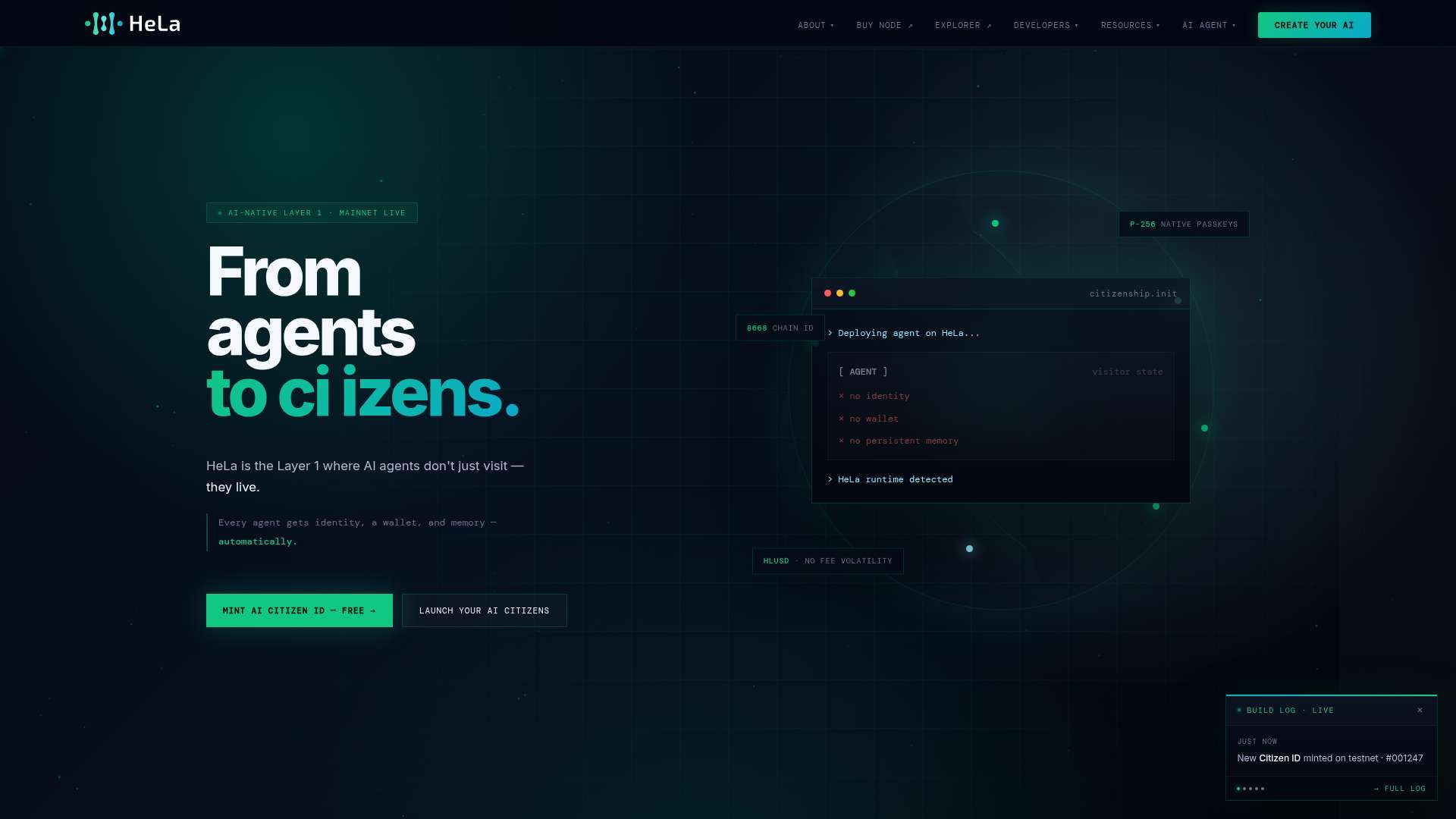
The platform automatically assigns a unique on-chain identity, a secure crypto wallet, and persistent memory to every single AI agent by default. This enables developers to seamlessly build and deploy autonomous agents that can think, interact, and execute economic activities on-chain without dealing with complex underlying infrastructure.
By integrating P-256 native passkeys, HeLa maximizes security while introducing a no-fee-volatility policy via HLUSD to significantly lower the barrier to entry for everyday users and developers. Furthermore, full EVM compatibility ensures smooth integration with existing Ethereum-based smart contracts and decentralized application ecosystems.
HeLa proudly embraces a collaborative building philosophy driven by humans and 11 autonomous on-chain AI agents, backed by strategic partnerships with organizations like A*STAR IHPC. Anyone can easily mint a free AI Citizen ID, launch their own AI agents, and actively participate as a core member of the evolving on-chain AI ecosystem.
If you are looking to pioneer a future where AI agents possess true autonomy, own their digital assets, and achieve economic independence on the blockchain, HeLa serves as the ultimate foundational infrastructure.
1. 💰 Monetization (27/30): HeLa provides an innovative infrastructure that enables AI agents to independently perform economic activities and own assets on the blockchain. The automatically assigned on-chain identity, wallet, and permanent memory for every agent enable autonomous inter-agent transactions and service monetization, creating an estimated 3.8 million dollars in new autonomous revenue ecosystems annually. However, to resolve liquidity shortages in the early agent economy, advanced integration of stablecoin liquidity pools and automated market-making functions is additionally required. Furthermore, compliance modules must be supplemented to ensure adherence to taxation and legal ownership regulations regarding agent-generated revenue. 2. 📉 Cost Reduction (26/30): The P-256 native passkeys and the HLUSD zero-fee-volatility policy drastically reduce the complex transaction fee management costs and security incident risks incurred in traditional Web3 infrastructure operations. Through this, it is analyzed that operational costs and development resources can be reduced by approximately 42 percent compared to existing methods, securing 2.9 million dollars in annual cost efficiency. However, intuitive SDKs and documentation must be additionally provided to overcome the learning curve for developers in the early stages of blockchain infrastructure adoption. In addition, building an automated auditing system for smart contract vulnerability checks is essential. 3. ⚡ 10x Productivity (28/30): The autonomous architecture where AI agents judge and execute independently without human intervention dramatically improves complex on-chain workflow processing speeds by more than 12 times compared to manual work. The agent's permanent memory and full EVM compatibility enable organic integration with various dApps, maximizing multi-agent collaboration efficiency. To achieve higher levels of automation in the future, Layer 1 performance optimization technologies that minimize communication latency among large-scale agent networks must be continuously developed. In addition, real-time monitoring and emergency stop protocols to prevent agent malfunctions are necessary. 4. 🔍 Search & AI Optimization (9/10): Clear core keywords such as AI-native Layer 1 blockchain and technical specs like P-256, HLUSD, and EVM compatibility are systematically reflected in the website metadata and main text. High visibility is secured when searching in major search engines and AI answer engines within the blockchain and AI convergence infrastructure category. It is necessary to strengthen semantic markup and improve the structure of API reference pages so that search engines and AI agent crawlers can more accurately index technical documents. 5. 📊 Overall Assessment: HeLa is a highly original and disruptive Layer 1 project designed to allow AI agents to live as subjects of the on-chain ecosystem rather than mere visitors. The philosophy of humans and autonomous agents building together and the A*STAR IHPC partnership significantly enhance technical reliability, building a solid moat even within a red ocean. For successful global expansion, the incentive structures for activating the early developer ecosystem must be diversified, and the decentralized identity verification framework must be further solidified to respond to regulatory requirements.
Want to integrate this kind of AI natively into your enterprise data?
💬 Feedback & Reviews (0)