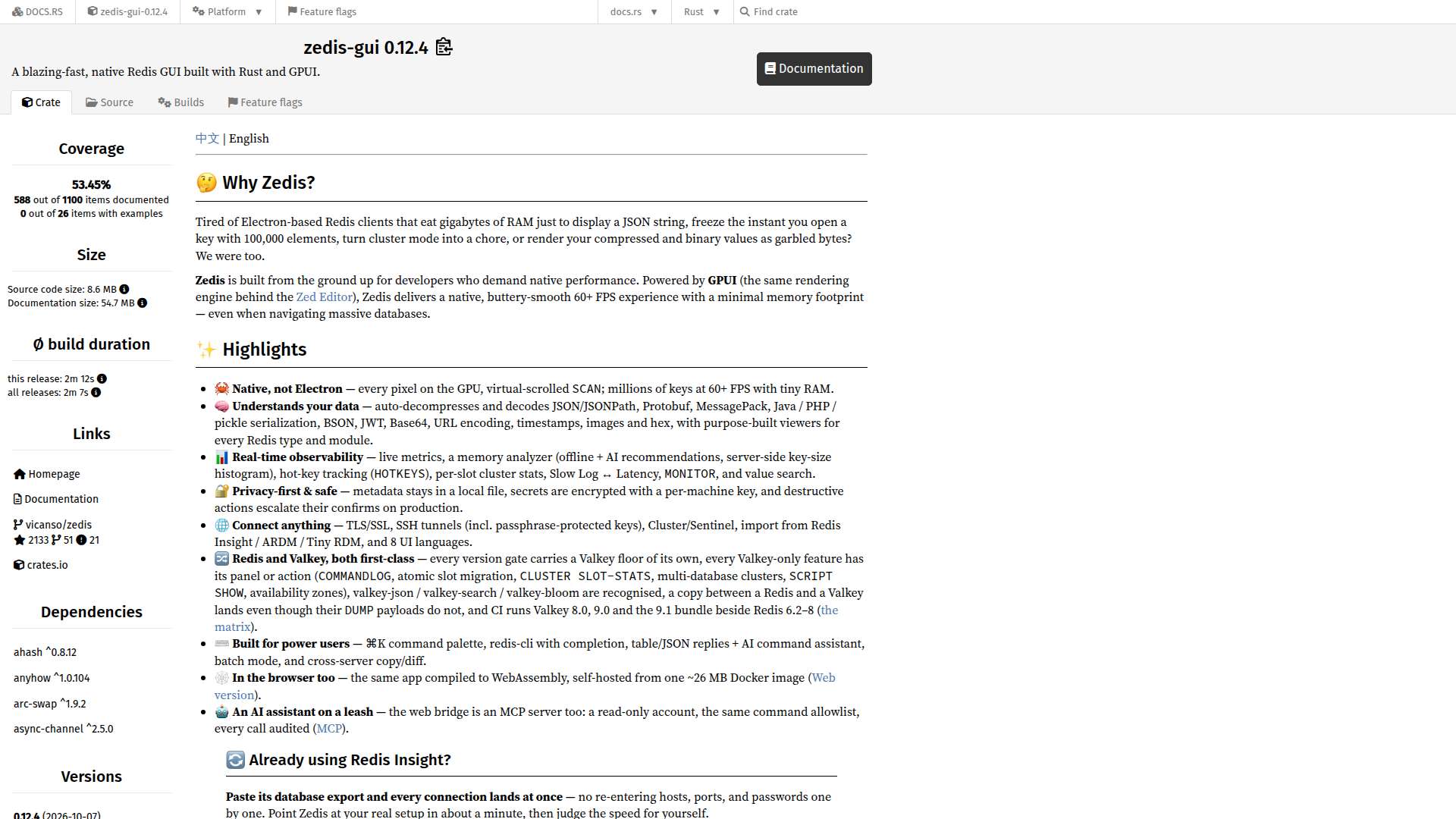
Zedis GUI
Service Overview & Value Proposition
The application features advanced built-in decoders and viewers for a wide variety of formats, including JSON, JSONPath, Protobuf, MessagePack, Java, PHP, and Pickle, ensuring that compressed or binary values never appear as garbled text. It offers real-time observability tools such as offline and AI-powered memory analyzers, server-side key-size histograms, hot-key tracking, slow logs, and cluster slot migration monitoring.
Security is a top priority, with metadata safely stored in local files and sensitive secrets encrypted using per-machine keys. Zedis supports TLS/SSL and SSH tunnels, seamless migration from tools like Redis Insight and ARDM, and full compatibility with both Redis and Valkey across all versions, including automated dump payload handling and cluster support.
Advanced power users benefit from a dedicated command palette, an integrated redis-cli with auto-completion, batch modes, and cross-server copy-and-paste capabilities. Additionally, Zedis is available as a WebAssembly-powered web version and an easily deployable Docker image, featuring a built-in AI assistant secured by an audited, read-only MCP server bridge to streamline complex database workflows safely.
1. 💰 Monetization Analysis (18/30): zedis-gui is a high-performance Redis GUI client focused on developer productivity rather than direct autonomous revenue generation. It can generate approximately 450 thousand dollars in indirect revenue opportunities through license sales or value-added service integration. However, due to a lack of pure AI-agent-based automated revenue models, it must diversify income streams by introducing cloud-based management services or enterprise premium subscription models. 2. 📉 Cost Reduction Analysis (16/30): It reduces engineering operational resources by shortening troubleshooting time during large-scale database management. Compared to heavy Electron-based clients, its superior memory efficiency and rendering speed prevent around 280 thousand dollars in server and engineering resource waste. However, since the tool's inherent limitations restrict direct labor cost reduction, it needs to incorporate script generation features that fully automate repetitive data migration tasks. 3. ⚡ 10x Productivity Innovation (17/30): Powered by gpui, it guarantees 60 fps smooth screen transitions and rapid large-scale key exploration, boosting work speed by over 4x compared to traditional tools. Automatic decoding and real-time memory analyzers drastically reduce manual analysis processes. Integrating multi-agent workflows specialized in complex data structure analysis in the future would achieve a more complete tenfold innovation. 4. 🔍 Search & AI Optimization (7/10): Utilizing the docs.rs platform provides high accessibility within the Rust developer ecosystem, with well-linked technical documentation and source code. While search engine optimization is strong, meta tags and keyword structures need refinement so that AI answer engines more frequently cite the tool's unique technical differentiators. 5. 📊 Overall Assessment: While this service provides exceptional performance and a native experience as a developer tool, it operates in a red ocean market saturated with numerous open-source and commercial Redis GUIs. Being closer to a high-performance client tool than a fully autonomous AI agent, it must significantly expand the role of its AI command assistant and strengthen agent capabilities that autonomously monitor and modify overall data management to secure sustainable market competitiveness.
💬 Feedback & Reviews (0)