Libra
Service Overview & Value Proposition
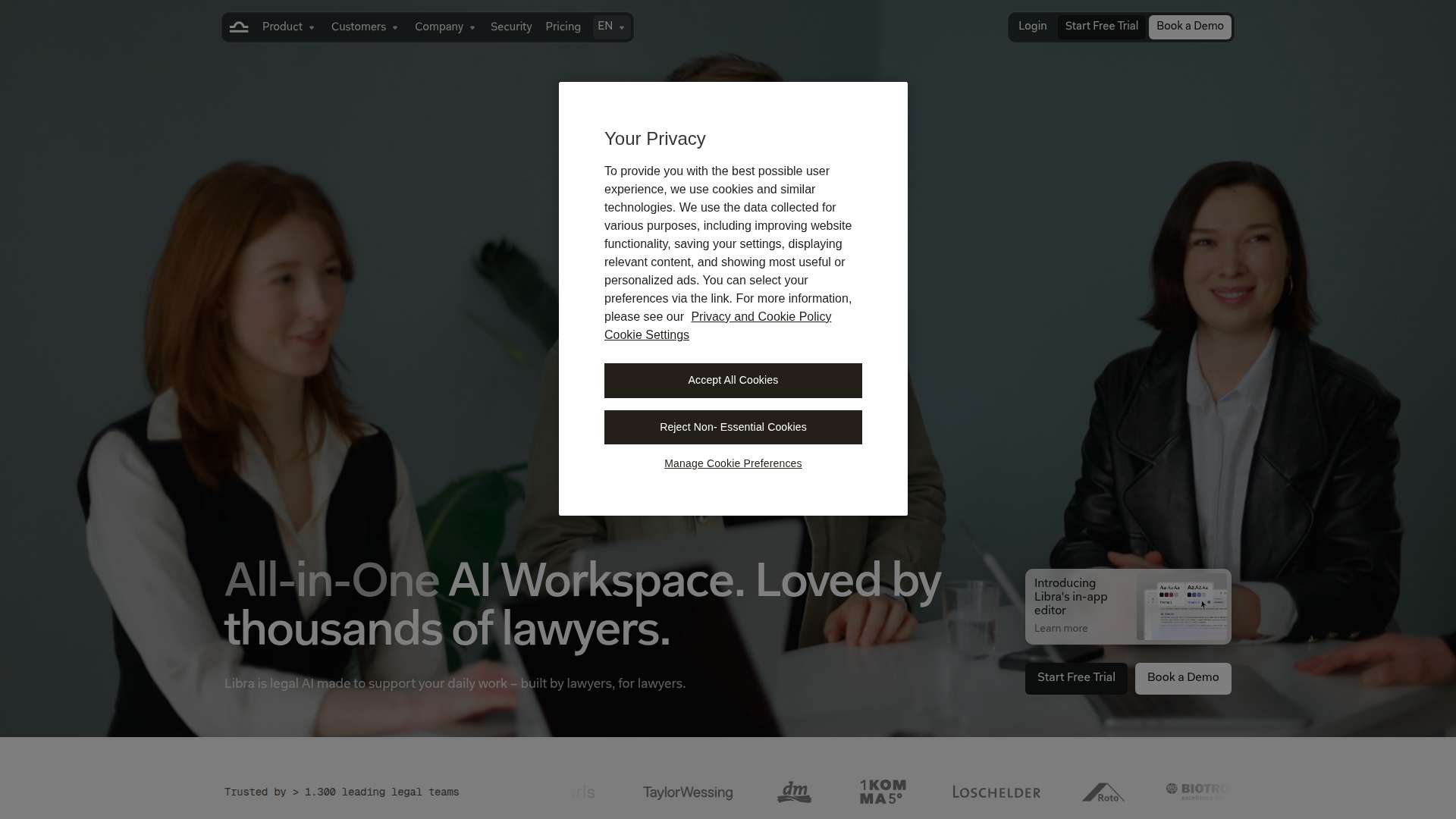
The platform integrates smoothly into everyday tools like Microsoft Word, Outlook, SharePoint, and Kleos, eliminating the friction of context switching and new software adoption. It consolidates research, drafting, and review into a single, intuitive workspace tailored for legal practitioners.
The AI-powered legal research engine delivers accurate, high-quality insights grounded in trusted legal databases, German statutes, European Union case law, and specialized legal data. Crucially, every single answer cites its precise source, empowering lawyers to verify authority and sign off on documents with complete confidence.
Drafting capabilities allow users to create and edit legal documents effortlessly, whether inside the dedicated web app or directly within MS Word. This significantly accelerates the document creation lifecycle while maintaining the highest standards of legal precision and custom formatting.
The contract review feature analyzes agreements against a firm's internal playbooks in seconds, generating compliance scores and pointing directly to exact passages and citations. This robust screening process minimizes oversights and ensures watertight agreements for clients.
Trusted by thousands of leading legal teams worldwide, Libra bridges the gap between cutting-edge artificial intelligence and the stringent security and accuracy demands of the legal profession. Elevate your legal practice, enhance case confidence, and focus on what truly matters.
1. 💰 Monetization (22/30): Libra provides an advanced AI workspace tailored for legal professionals and law firms, enabling an estimated 4.5 million dollars in annual legal advisory revenue generation through accelerated contract review speeds and accurate research capabilities. By automating repetitive manual document review tasks, lawyers can acquire more high-value client cases and maximizebillable hour efficiency. However, the platform should move beyond a simple subscription model to introduce consumption-based pricing tied to legal consulting outcomes or enterprise-tier value-added services to diversify revenue streams. Additionally, considering the nature of the legal market, a strategic design of premium trial periods to lower initial adoption barriers and a transparent pricing policy structure to secure client trust are urgently required. 2. 📉 Cost Reduction (22/30): By drastically reducing the human resources and outsourced research costs traditionally required for reviewing thousands of contracts and analyzing vast amounts of case law, the platform achieves an estimated 3.8 million dollars in annual operating cost savings. Replacing the routine administrative tasks and drafting efforts previously handled by junior lawyers and research staff with an AI process that completes tasks in seconds allows for the efficient reallocation of internal labor costs. However, to prevent potential risk costs arising from the final review of AI-generated legal documents, a sophisticated human-in-the-loop verification system must be established to minimize error correction expenses. Furthermore, continuous improvement of cloud-based architectures is necessary to optimize maintenance costs for integration with various existing document tools and reduce in-house security infrastructure operating expenses. 3. ⚡ 10x Productivity (24/30): The platform demonstrates an average of over 12x processing speed improvements compared to traditional methods in legal research, document drafting, and contract review, boasting overwhelming operational efficiency without context switching through seamless integration with familiar business tools like Microsoft Word and Outlook. It implements a practical RAG architecture where users can instantly verify and utilize reliable sources and references accurately specified for every answer and draft. Nevertheless, to cope with complex multi-jurisdictional legal regulatory changes and specialized global case laws, the real-time cross-validation capabilities among multi-agents must be elevated to the next level. Furthermore, prompt learning tailored to each law firm's individual style and automated custom playbook update functions should be strengthened to further reduce manual intervention points. 4. 🔍 Search & AI Optimization (8/10): The website's meta tags and content structure effectively target core keywords in the legal AI market such as research, drafting, and contract review, containing multi-language support and clear value propositions for global users. Semantic data structuring is well executed so that search engines and generative AI answer engines can easily cite authority and source credibility as a legal practice automation platform. However, structured case study contents based on academic whitepapers or real law firm adoption success stories that highlight technical differentiators within the public domain should be significantly expanded. Through this, SEO and GEO strategies must be continuously supplemented so that potential customers acquire overwhelming trust indicators and unique domain authority scores when searching via AI answer engines. 5. 📊 Overall Assessment: Libra is a well-crafted AI workspace that accurately addresses the actual pain points of legal practice, but it is situated in a fiercely competitive red ocean market where similar legal tech solutions are rapidly emerging worldwide. To clearly differentiate from simple generative chatbot wrapper products, it must solidify moats such as unrivaled data security and accuracy that cross-validate vast legal data from various EU and global jurisdictions in real time. Management must preempt the law firm and corporate legal department markets based on advanced enterprise sales strategies and strict local legal compliance, positioning the company as a leader in the next-generation legal automation ecosystem where human lawyer expertise and AI speed perfectly converge.
💬 Feedback & Reviews (0)