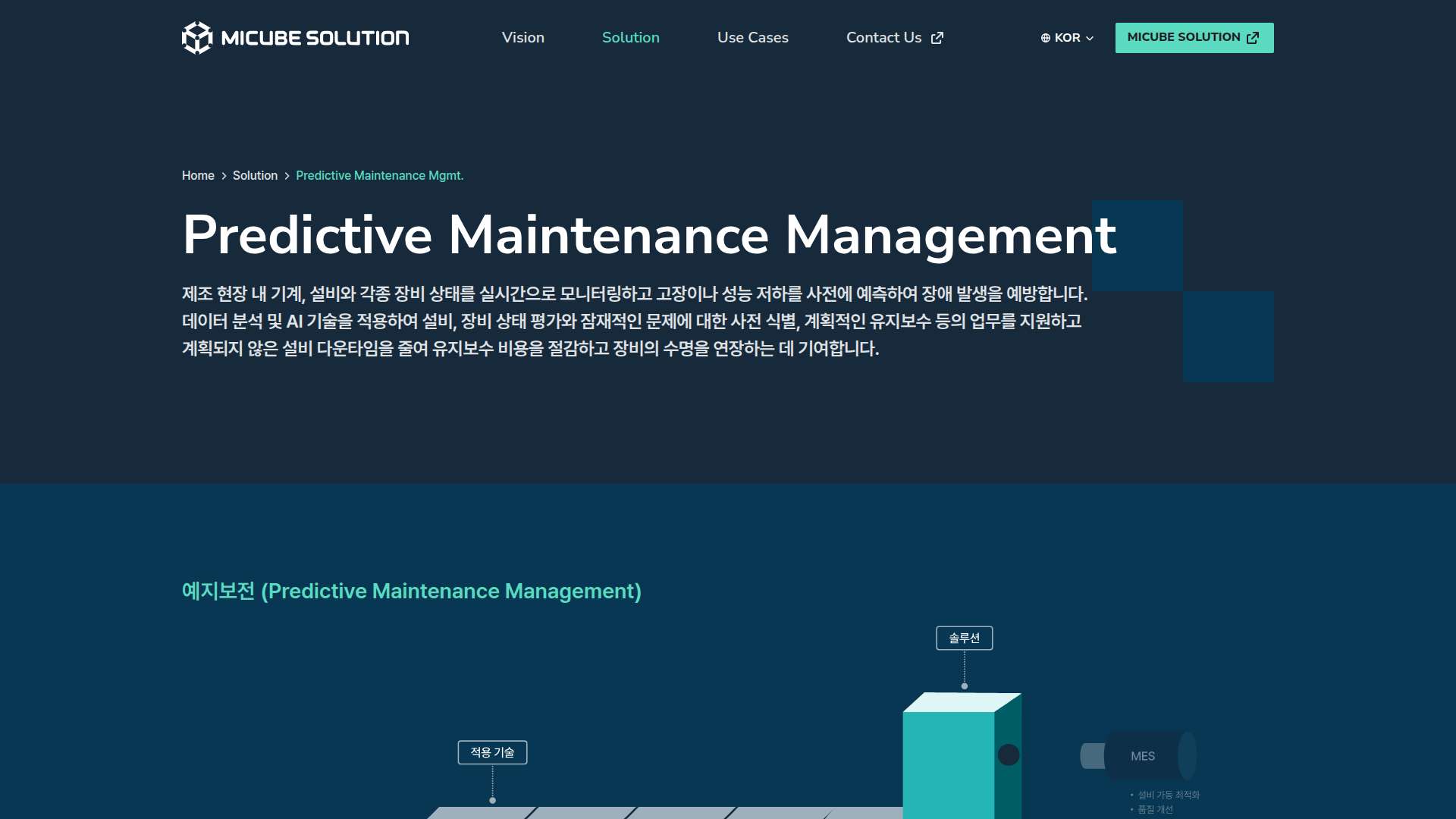
MICUBE SOLUTION Predictive Maintenance Management
Service Overview & Value Proposition
It drastically reduces unplanned equipment downtime in manufacturing processes, helping enterprises save maintenance costs and extend the operational lifespan of critical assets. The platform collects real-time equipment data and constructs a data lake for robust analysis, adopting distributed streaming methods to seamlessly integrate massive data from multiple touchpoints.
Furthermore, it maintains predictive performance through continuous AI model retraining to counter model degradation and refine failure prediction accuracy. By monitoring the correlation between equipment operations and production quality, the system rapidly detects anomalies in parts and components, elevating prediction accuracy by leveraging both historical and real-time data.
It offers maintenance schedule optimization by recommending the best maintenance timelines based on equipment conditions and predicted failure points. By integrating with digital twin platforms, it generates virtual equipment models and executes operational scenario-based simulations for comprehensive pre-verification of maintenance schedules.
The integrated predictive maintenance dashboard provides a unified view of real-time equipment status, failure forecasts, maintenance schedules, and key performance indicators. Automated periodic reporting ensures continuous monitoring of data analysis results and delivers immediate alerts when anomalies occur.
By predicting problems before they manifest and executing preventive measures, it minimizes production interruptions and maintains a stable manufacturing environment. It serves as an innovative digital transformation partner for modern manufacturing companies seeking to maximize equipment utilization rates and overall productivity.
1. 💰 Monetization (26/30): Micube Solution's predictive maintenance system has the strong potential to generate approximately 3.2 million dollars in annual production opportunity cost savings by proactively preventing unexpected facility downtimes. By accurately predicting machine failures through sensor data and data lake-based real-time analysis, it completely cuts off revenue losses caused by production line interruptions. Furthermore, it maximizes asset value and enhances production efficiency through digital twin-based simulations that derive optimal maintenance schedules. However, to further maximize revenue in the future, it is necessary to expand into an advanced business model that integrates supply chain management and inventory optimization beyond component-level lifespan prediction to collectively manage spare parts procurement costs. 2. 📉 Cost Reduction (25/30): This solution achieves significant operational cost savings of approximately 1.9 million dollars annually by drastically reducing unnecessary preventive maintenance expenses and emergency repair outsourcing costs through continuous monitoring and automated anomaly detection. Thanks to the automated retraining function of AI models combining historical and real-time data, it effectively eliminates unnecessary man-hours spent by maintenance personnel on manual status checks and checklist creation. Consequently, it prevents the waste of maintenance resources and enhances material management efficiency, greatly strengthening manufacturing cost competitiveness. However, for additional cost reduction, it requires the refinement of resource allocation algorithms that automatically match AI-derived maintenance schedules with on-site workers' actual schedules and skill levels to minimize outsourced labor dependency. 3. ⚡ 10x Productivity (26/30): It reduces the analysis time required for equipment condition assessment and potential problem identification by over 90% compared to traditional manual methods, drastically improving overall factory productivity by maximizing equipment uptime. Real-time data integration across numerous contact points via distributed streaming enables delay-free management, and the integrated dashboard helps on-site managers identify key performance indicators and anomalies within seconds. Simulation-based preliminary verification eliminates trial and error during work planning and maximizes work efficiency. Furthermore, to achieve true 10x innovation, user experience innovation must be supplemented by introducing generative AI-based natural language query functions so that on-site engineers can immediately receive equipment status and action guides via voice or text. 4. 🔍 Search & AI Optimization (8/10): Core keywords such as predictive maintenance, facility monitoring, AI equipment management, digital twin, and smart factory are strategically placed throughout the website structure, securing excellent visibility in major search engines within the smart factory sector. In particular, professional terms such as data lake, distributed streaming, and digital twin simulation are well embedded in the technical introduction pages, guiding AI-based answer engines to accurately recognize the technical identity of the solution. However, to further enhance search exposure in global AI search engines and vibe-coding-based chat tools, technical whitepapers in English, detailed architecture diagrams, and specific case study data demonstrating actual adoption effects should be additionally supplemented in web page meta tags and semantic markup. 5. 📊 Overall Assessment: Micube Solution's predictive maintenance system is an exceptionally outstanding smart factory solution that overcomes the limitations of traditional manufacturing and accelerates digital transformation. Although similar monitoring tools already exist in the market, the unique architecture combining data lake analysis and digital twin simulation creates a clear technical differentiation even within a red ocean. Management can secure mid-to-long-term global manufacturing competitiveness by perfectly virtualizing physical assets on-site and building an autonomous maintenance ecosystem through the adoption of this solution. To maintain a sustained competitive advantage in the future, it is strongly recommended to evolve into a fully autonomous smart factory platform that minimizes human intervention by upgrading autonomous collaboration capabilities among agents.
Want to integrate this kind of AI natively into your enterprise data?
💬 Feedback & Reviews (0)