SciPhys
Service Overview & Value Proposition
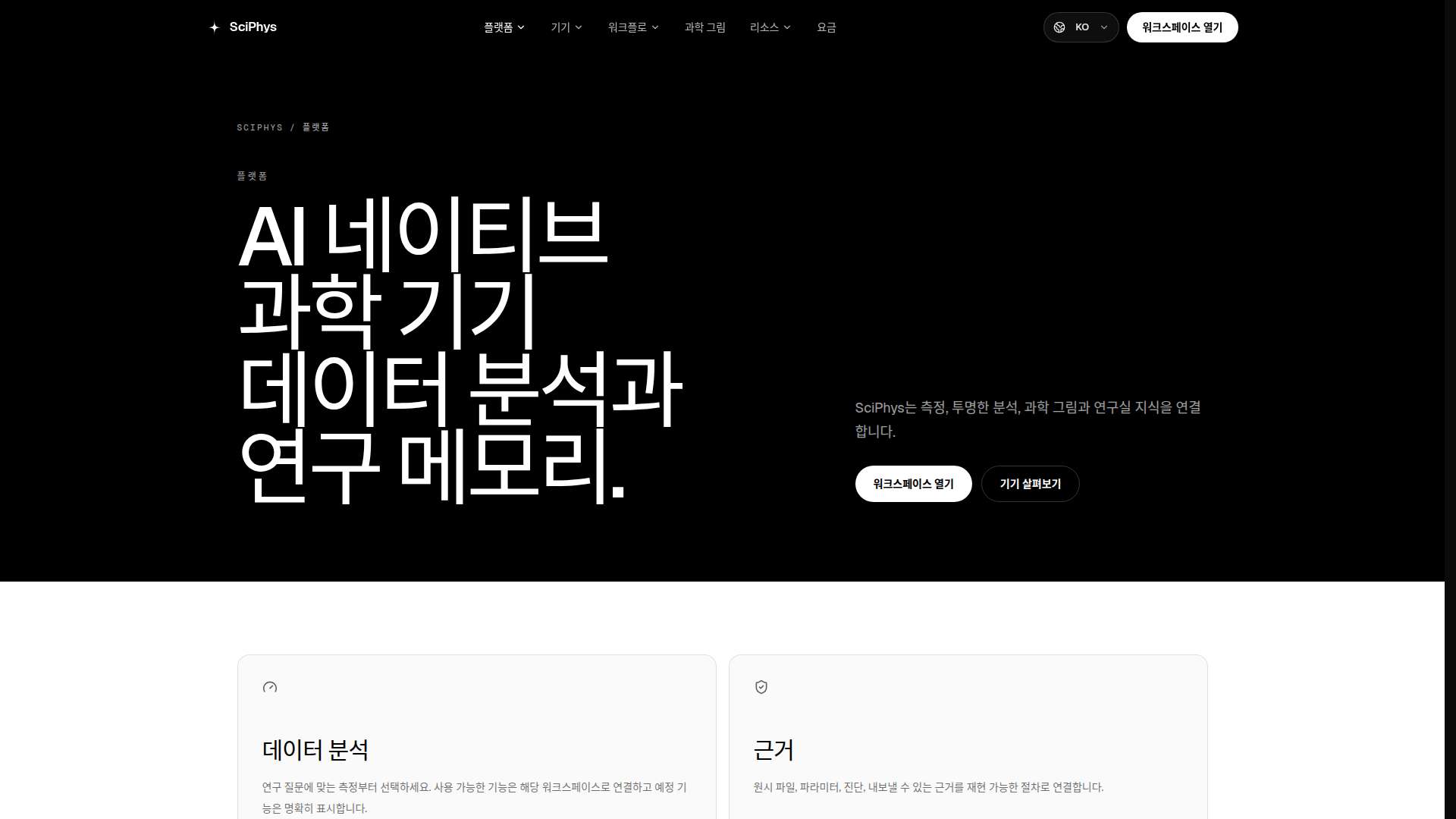
It helps researchers easily select the most appropriate measurement method for their research questions, optimizing workflows by clearly visualizing available and upcoming features.
From raw files, parameters, and diagnostic data to exportable evidence, SciPhys connects every step into a reproducible procedure, maximizing research reliability and transparency.
The Research Memory feature systematically stores and manages files, metadata, assumptions, results, and expert reviews connected to experiments without any omissions.
It turns verified scientific logic into editable, publication-ready scientific figures and visual outputs tailored for academic success.
For XRD (X-ray diffraction) analysis, it allows users to examine phase identification, reference peaks, and refinement residuals while exporting verifiable diffraction evidence.
It supports Raman and Photoluminescence (PL) spectroscopy to correct fluorescence backgrounds and precisely compare peak positions, full width at half maximum (FWHM), integrated areas, and intensity ratios.
The Time-resolved photoluminescence (TRPL) beta analysis fits decay models including instrument responses and residual diagnostics to report accurate lifetimes.
UV–Vis spectroscopy analysis creates reliable bandgap evidence with explicit fitting intervals and transition assumptions from absorbance or transmittance data.
In microscopy and surface analysis, Scanning electron microscopy (SEM) provides particle and morphological analysis while preserving scale calibration, segmentation evidence, and sampling contexts, while Atomic force microscopy (AFM) enables surface topography leveling and artifact review to report roughness and line profiles.
1. 💰 Monetization (25/30): SciPhys is a high-value platform integrating advanced scientific instrument data analysis and research memory, possessing a strong monetization model capable of generating 3.8 million dollars in annual economic value through improved R&D efficiency and reduced analysis errors. By integrating complex data from various scientific instruments such as XRD, Raman, PL, TRPL, UV-Vis, SEM, and AFM into a single agent workflow, it significantly reduces outsourced analysis costs for research institutions and high-tech enterprises. However, beyond the SaaS subscription model targeting global universities and research institutes, additional revenue diversification strategies such as pay-per-report generation for AI-customized analysis or integration with advanced research data marketplaces should be supplemented. In particular, strengthening network effects that induce knowledge asset sharing and collaboration among laboratories will further maximize B2B enterprise contract conversion rates. 2. 📉 Cost Reduction (24/30): It achieves an annual operational cost reduction of 2.9 million dollars by innovatively replacing human resources consumed in manual data calibration, fitting, parameter extraction, and manual report writing. By saving countless hours previously spent by researchers on repetitive scale calibration, artifact review, and fluorescence background correction, it creates an environment where they can focus on core research and experimental design. However, to minimize engineering resources consumed during initial instrument driver integration and custom equipment protocol support, standardized API integration modules must be further advanced. Additionally, ways to further reduce maintenance personnel by increasing parser automation rates addressing closed instrument file formats from various manufacturers must be devised. 3. ⚡ 10x Productivity (26/30): By automating the entire process from raw files, metadata, diagnostics, to publication-ready scientific figure generation, it realizes over 8x improvement in research productivity compared to conventional methods. Based on verified scientific logic, it supports instant editable fitting section setup and bandgap evidence generation, completing data verification tasks that used to take days in just a few seconds. To secure a higher level of autonomy in the future, a self-correcting feedback loop between multi-agents should be introduced to strengthen capabilities for self-detecting and correcting analysis errors. Furthermore, if intelligent research assistant features that proactively suggest the next experimental steps based on user-input experimental assumptions and results are expanded, true 10x innovation can be achieved. 4. 🔍 Search & AI Optimization (9/10): Site titles, meta tags, scientific instrument terminology, and technical specs are systematically reflected in the HTML context, showing exceptional exposure suitability in major search engines and AI answer engines. High-involvement keywords frequently searched by academic and industrial researchers such as XRD, Raman, TRPL, and AFM are naturally positioned, effectively driving target audience traffic. To increase direct citation rates by AI search engines and conversational LLM bots in the future, structured JSON-LD academic data schemas and detailed technical whitepaper content must be continuously expanded. Also, open case studies and benchmark data linked with the global research community should be prominently exposed on the website to establish an authoritative reference. 5. 📊 Overall Assessment: SciPhys is a highly original platform with high technical barriers that transcends the limitations of general AI chatbots by combining scientific instrument domain knowledge and precise analysis algorithms. It accurately strikes the fragmented problems of traditional laboratory software, securing clear differentiation amidst a red ocean market. To successfully establish itself in the global market, it must simultaneously achieve an open ecosystem construction and strict data security certifications, requiring aggressive R&D investment to leap into standard infrastructure for next-generation scientific research.
💬 Feedback & Reviews (0)