HEARTCOUNT
Service Overview & Value Proposition
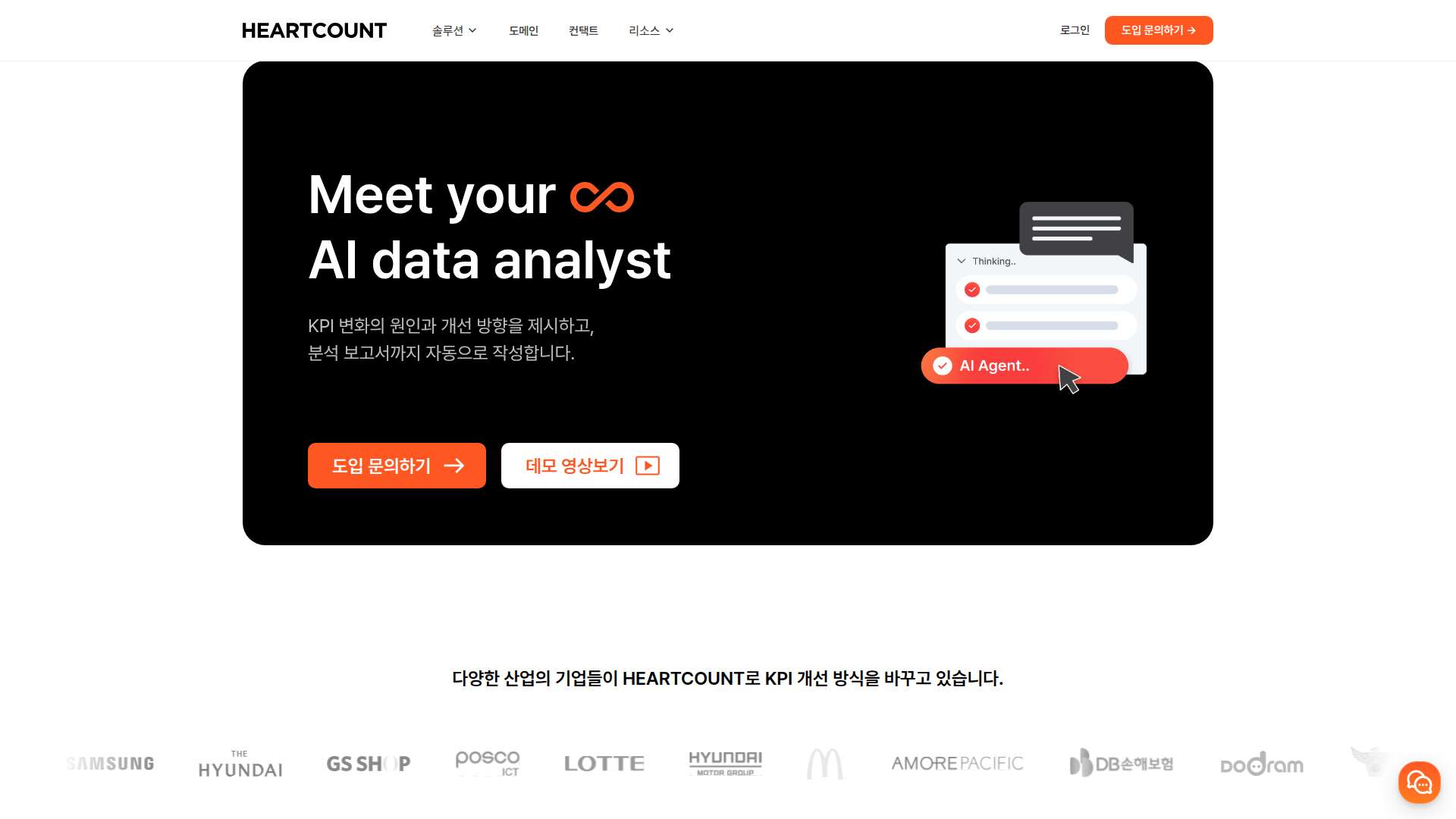
It revolutionizes the traditional, complex data analysis process, providing an intuitive environment where business practitioners can ask questions in natural language and receive immediate answers.
Through its AI Analytics & BI solution, HEARTCOUNT smoothly connects various databases (DB) and data warehouses (DW), visualizing key metric changes and trends at a glance.
When new questions arise while viewing a dashboard, users can immediately check results and interpret them deeply through AI analysis without having to re-extract data.
Powered by a proprietary AI analytics engine and Semantic MCP technology, the 'Decision Agent' accurately understands and learns your company's unique data structure and business context.
It autonomously explores and analyzes the causes behind changes in key metrics such as revenue, conversion rates, and KPIs, further suggesting concrete decision-making guidelines and improvement directions.
By automating repetitive reporting and data exploration tasks that were previously done manually, it completes comprehensive analysis reports in one go, maximizing operational efficiency.
It provides tailored use cases across various industries such as finance, insurance, retail, public sector, HR, and AICC, transforming how companies approach KPI improvement.
HEARTCOUNT helps companies make data-driven decisions by enabling them to grasp scattered data at a glance, detect anomalies in real-time, and build simulation-based performance management systems as a trusted business partner.
1. 💰 Monetization (26/30): Heartcount combines BI dashboards with an AI analysis engine to capture the root causes of core KPI changes in real time and suggest improvement directions, directly contributing to revenue growth and profit generation. By integrating various databases and data warehouses, it accurately diagnoses sales leakage points and drives rapid data-driven decision-making, possessing the structural potential to generate approximately 450 million KRW in additional annual revenue. Especially in the finance and retail domains, it maximizes profitability and minimizes opportunity costs through anomaly detection and simulation-based performance management systems. However, to continuously prove differentiated value in a market crowded with BI and data analytics solutions, it requires advancement into an autonomous framework that links beyond simple cause analysis to automatic execution of concrete action items. In addition, functional supplements such as enhancing the accuracy of industry-specific prediction models and shortening the learning speed of domain-specific metadata for each client must accompany to further widen the scope of monetization. 2. 📉 Cost Reduction (25/30): It drastically cuts massive operational resources and labor costs previously generated during manual data extraction, Excel processing, and repetitive report writing. By enabling business practitioners to perform data analysis directly through natural language queries, it eliminates bottlenecks relying on data analysts or IT departments, achieving an effect of reducing operational costs and resource expenditures by approximately 320 million KRW annually. As the creation of routine reports previously done manually is automated, an environment is fostered where employees can focus on high-value strategic establishment. However, since professional consulting and internal resources must be invested during the initial deployment process for enterprise data structure alignment and semantic MCP construction, the development of simplified migration tools to minimize indirect costs incurred during the initial onboarding period is necessary. Furthermore, continuous improvement of query efficiency algorithms is required to optimize cloud infrastructure operating costs. 3. ⚡ 10x Productivity (26/30): It provides a seamless workflow connecting questions arising from dashboards directly to AI analysis without data re-extraction, improving work processing speed by more than 10 times compared to before. As analysis time is shortened from days to seconds, the company's decision-making speed is maximized, and a data-driven management culture can quickly settle across the enterprise. The intuitive natural language-based interface empowers non-expert business practitioners to derive deep insights without writing complex SQL. However, to reduce response delays occurring when processing complex multi-table joins or large data sets during advanced analysis processes, the technical perfection of caching and indexing architecture must be further elevated. In addition, functional scalability is required to strengthen collaborative systems among multi-agent architectures to autonomously execute complex business scenario simulations beyond simple Q&A. 4. 🔍 Search & AI Optimization (8/10): Sitemap.xml and robots.txt are systematically configured, and major solution pages are smoothly indexed by search engines. An llms.txt file for AI answer engines is established, providing an environment where AI bots can accurately understand and summarize the platform's core functions and solution structures. Core keywords such as business intelligence, KPI analysis, and decision agents are appropriately placed in meta titles and descriptions, ensuring excellent search visibility. However, to further expand inbound traffic from global markets and potential customers, use case scenarios by major industry and technical whitepaper content must be reinforced, and structured data markup must be expanded. In addition, a strategic approach is needed to continuously publish professional content based on long-tail keywords within tech blogs and guide documents to increase citation frequency in AI-based search engines. 5. 📊 Overall Assessment: Heartcount is a highly completed platform connecting BI, AI analytics, and decision agents into a single ecosystem, serving as an excellent solution that lowers the barrier to entry for data analysis and creates practical business value. However, since the data analytics and BI market is a fierce red ocean area competing with traditional global giants to numerous AI startups, proving clear differentiation through customer success cases is essential beyond technical perfection. When adopting this system, management should utilize it not merely as a functional introduction, but as core infrastructure linked to enterprise data culture innovation to shorten KPI improvement cycles. To secure an unrivaled market position in the future, it must elevate the sophistication of its proprietary AI model and further strengthen industry-specific vertical agent functions to leap into a global standard BI and AI analysis platform.
Want to integrate this kind of AI natively into your enterprise data?
💬 Feedback & Reviews (0)