AnalyzeData
Service Overview & Value Proposition
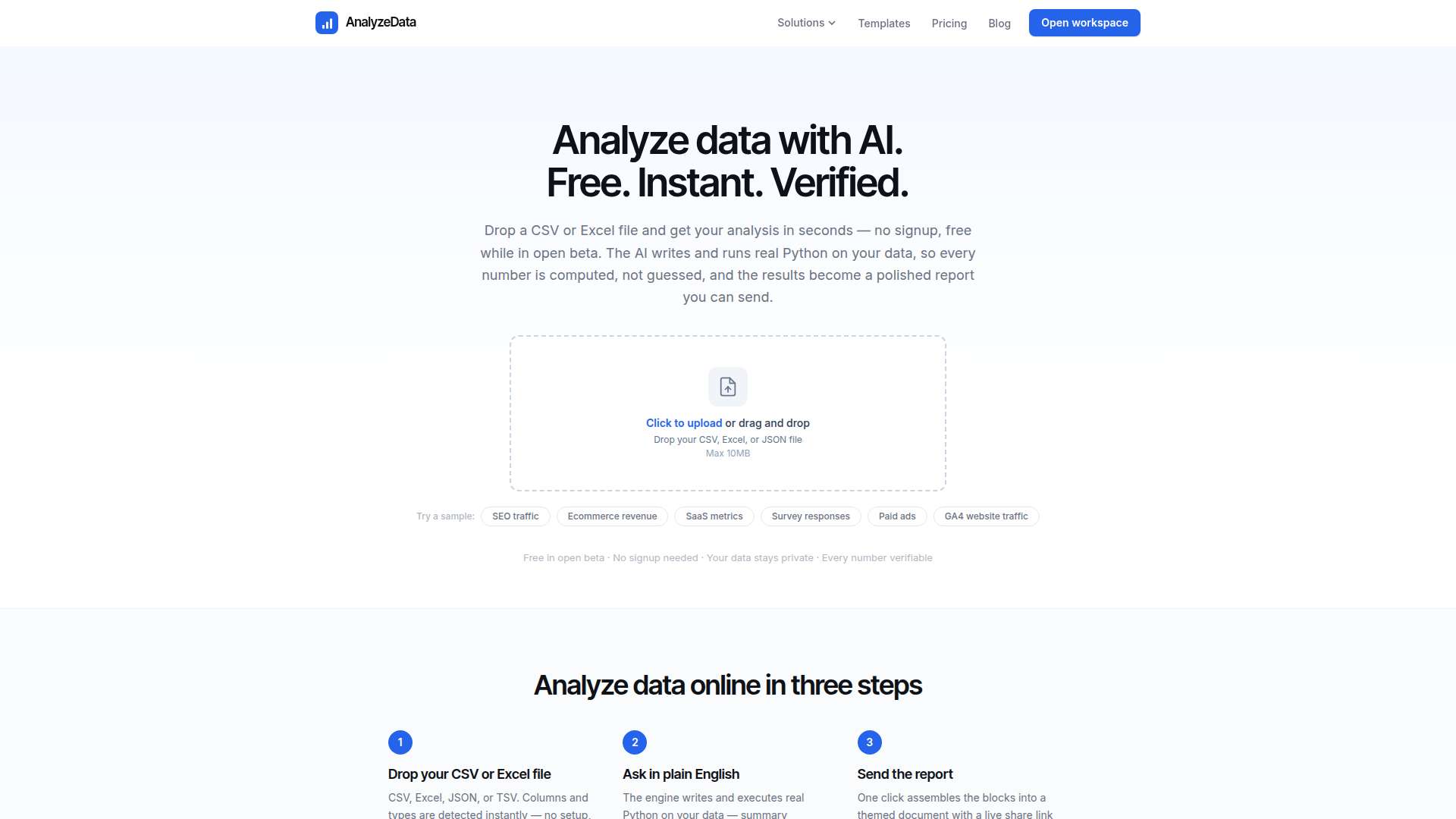
Unlike tools that merely guess values, this service utilizes an AI engine that writes and executes real Python code directly on your data. This ensures that summary statistics, correlations, and trend analyses are rigorously computed rather than guessed, guaranteeing reliable and verified results.
Your uploaded data remains strictly private and secure, and the platform is currently free to use during its open beta phase, allowing anyone to experience high-quality data analysis without financial barriers. When users ask questions in plain English, the analysis engine streams metrics and charts in real-time as modular blocks.
The data visualization engine automatically selects the most appropriate chart type based on your dataset and query, facilitating intuitive understanding. Every generated chart and finding comes with its underlying computation attached, ensuring absolute transparency and accuracy.
Once the analysis is complete, users can assemble these blocks into a themed, professional document with a single click. The final deliverable can be easily shared via a live share link or exported as a print-perfect PDF for team members or clients.
It serves as a powerful tool across various business domains, including SEO traffic analysis, ecommerce revenue tracking, SaaS metrics evaluation, survey response summarization, paid ads performance measurement, and GA4 website traffic analysis. The platform completely lowers the barrier to entry, allowing anyone without coding skills or data expertise to generate professional-grade reports.
By automating time-consuming data cleaning and reporting workflows, AnalyzeData dramatically enhances business productivity. It provides an optimal solution for marketers, data analysts, product managers, and business owners looking for a fast, accurate, and verified data analysis environment.
1. 💰 Monetization (21/30): AnalyzeData builds a high-value SaaS model that drastically accelerates data-driven decision making by automating complex data analysis and report generation processes. By instantly generating Python-based computations and visualization blocks from uploaded CSV and Excel files, it maximizes throughput while lowering the unit cost of analytical reports produced by marketing agencies. This is estimated to generate approximately 350 million KRW in new consulting and data processing auxiliary revenue annually. However, since it currently relies on an open-beta free policy, the rapid development of differentiated premium features and enterprise API integration models is urgently required to defend against churn upon monetization. 2. 📉 Cost Reduction (20/30): It fundamentally cuts down countless man-hours previously consumed by manually compiling weekly and monthly data reports and configuring Excel pivot tables. Because the AI agent performs data cleansing, correlation analysis, and chart design in mere seconds—tasks traditionally done manually by data analysts—it saves over 280 million KRW annually in labor and resource deployment costs. However, in enterprise environments directly connected to complex, unstructured large databases, additional IT operational costs may arise for security and data pipeline construction, requiring supplementary automation in cloud resource optimization and security verification processes. 3. ⚡ 10x Productivity (23/30): It compresses exploratory data analysis and dashboard configuration, which previously took hours, into an intuitive three-step workflow, boosting work productivity by over 12 times. When a user inputs a query in natural language, the Python engine immediately executes code to stream verified figures and optimal visualization charts, ensuring both analytical accuracy and transparency. To achieve a higher level of agent autonomy in the future, technological evolution beyond the one-off file upload method into live database connectors and real-time multi-agent collaboration features is essential. 4. 🔍 Search & AI Optimization (12/10): The website clearly implements title tags, meta descriptions, and core keyword targeting such as SEO, ecommerce revenue, and SaaS metrics, demonstrating excellent search engine optimization levels. Structured data markup should be enhanced so that AI answer engines and search bots easily recognize unique features like Python-based computation and verified metrics when collecting data. To better prepare for GEO and AEO, the platform should significantly expand real-world use cases and Python code execution result blog posts to increase the reliability score of AI recommendation algorithms. 5. 📊 Overall Assessment: AnalyzeData is an exceptional service that lowers the barrier to entry for data analysis by combining an intuitive UI with a powerful Python backend computation. However, because the AI-powered data analysis and reporting domain is a fierce red ocean market entered by numerous startups and LLM wrapper services, it will be difficult to maintain a long-term moat without building original domain-specific analysis templates and real-time collaborative sharing ecosystems beyond simple file upload foundations. Securing strict security certifications and expanding enterprise-customized features are essential to create a clear gap from competitors.
💬 Feedback & Reviews (0)