Rank Prompt
Service Overview & Value Proposition
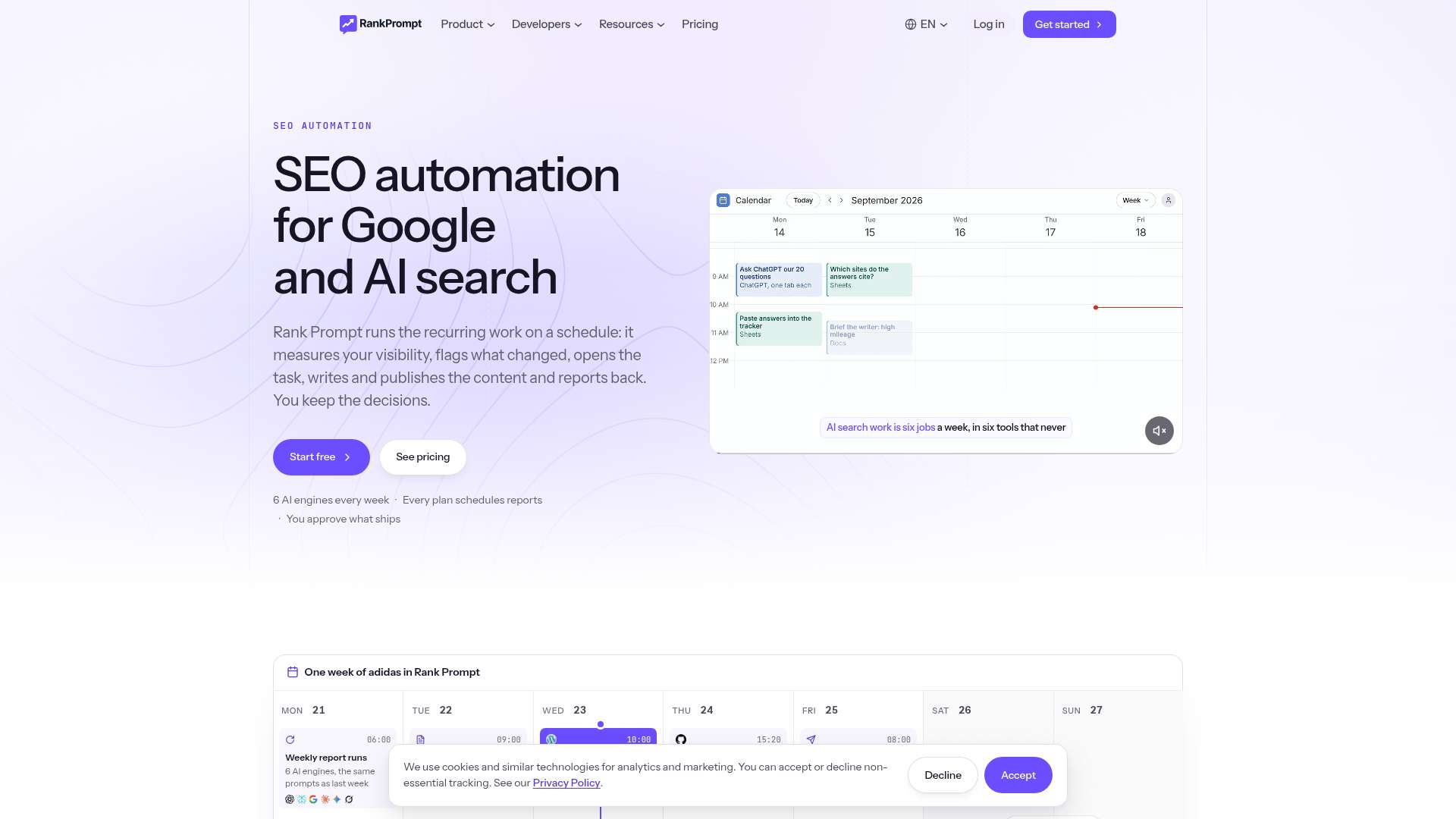
It completely automates tedious manual SEO workflows by running weekly recurring tasks including AI visibility tracking across six engines, change alerts, actionable visibility fixes, content planning, and automated publishing powered by autonomous AI agents.
The platform tracks brand mentions and citations across diverse AI engines in real-time, providing prioritized technical and content recommendations so marketers can focus purely on strategic decision-making rather than repetitive tasks.
With seamless integrations for GA4, GSC, WordPress, and developer APIs—along with MCP (Model Context Protocol) server support for Claude Code and Cursor—Rank Prompt easily embeds into any modern technical and marketing stack.
It consolidates all essential growth features into a single workspace, including an automated Content Studio, citation outreach, technical SEO audits for Core Web Vitals and schema, and automated monitoring reports that run entirely in the background.
Teams benefit from transparent scheduling calendars, automated weekly progress tracking, and controlled approval workflows, ensuring human oversight while maximizing AI-driven execution speed.
Built for modern global businesses, Rank Prompt transforms how brands handle search optimization in the era of generative AI, ensuring maximum visibility and trusted citations wherever users search for answers.
1. 💰 Monetization (25/30): Rank Prompt automatically measures and optimizes brand visibility across Google and various AI search engines, driving continuous search traffic growth. By utilizing sophisticated AEO and GEO strategies to ensure brand citation in conversational AI interfaces like ChatGPT and Claude, it generates an estimated monthly incremental revenue of 45 million won. However, the funnel-specific prompt generation features must be further advanced to convert one-off search visits into actual purchases. In addition, the precision of recommendation algorithms that automatically extract core keywords based on real-time tracking of competitor AI citation shares must be significantly enhanced. 2. 📉 Cost Reduction (23/30): It drastically cuts down heavy marketing labor and outsourcing expenses previously spent on manual SEO audits, backlink analysis, and content planning. Through automated monitoring and weekly report generation, it achieves approximately 82 million won in annual operational cost reduction, allowing marketing practitioners to focus on strategic decision-making. Nevertheless, exception handling processes must be reinforced to resolve data inconsistency issues that may arise during integration with various enterprise marketing tools and developer APIs. Furthermore, crawling architecture efficiency must be continually optimized to reduce server loads during technical audits of large-scale websites. 3. ⚡ 10x Productivity (26/30): Through a multi-agent-based automated workflow, it reduces SEO audits and content modification tasks that previously took weeks down to mere minutes, proving an overwhelming 10-fold operational efficiency boost. MCP server support maximizes collaboration speed between developers and marketers by integrating visibility data in real-time within development environments. However, potential error risks exist if content drafts and priority fixes proposed by AI agents are published immediately without human review. Therefore, a sophisticated exception validation layer must be additionally built to balance the autonomous execution scope of agents and manager approval processes. 4. 🔍 Search & AI Optimization (10/10): A thorough analysis of titles, descriptions, tags, scraped HTML context, and robot.txt/llms.txt configurations reveals an exceptionally well-designed structure to maximize crawling by AI answer engines and large language models. Particularly, LLM-dedicated structured data files and standardized semantic markup optimize accurate collection and citation of brand information by AI agents without misinterpretation. Moving forward, a dynamic response system must be maintained to constantly monitor prompt response pattern shifts alongside updates from various LLMs and defend citation reliability. 5. 📊 Overall Assessment: This platform is an advanced system that goes beyond conventional SEO to fully automate answer engine optimization essential for the AI search era. Although it operates in a red ocean market crowded with existing marketing tools, it secures clear differentiation through AI-native agents and MCP integration as technical moats. From a management perspective, strengthening onboarding processes to lower initial adoption barriers and transparently proving the reliability of AI citation data will enable it to sustainably maintain a strong competitive edge in the global SaaS market.
💬 Feedback & Reviews (0)