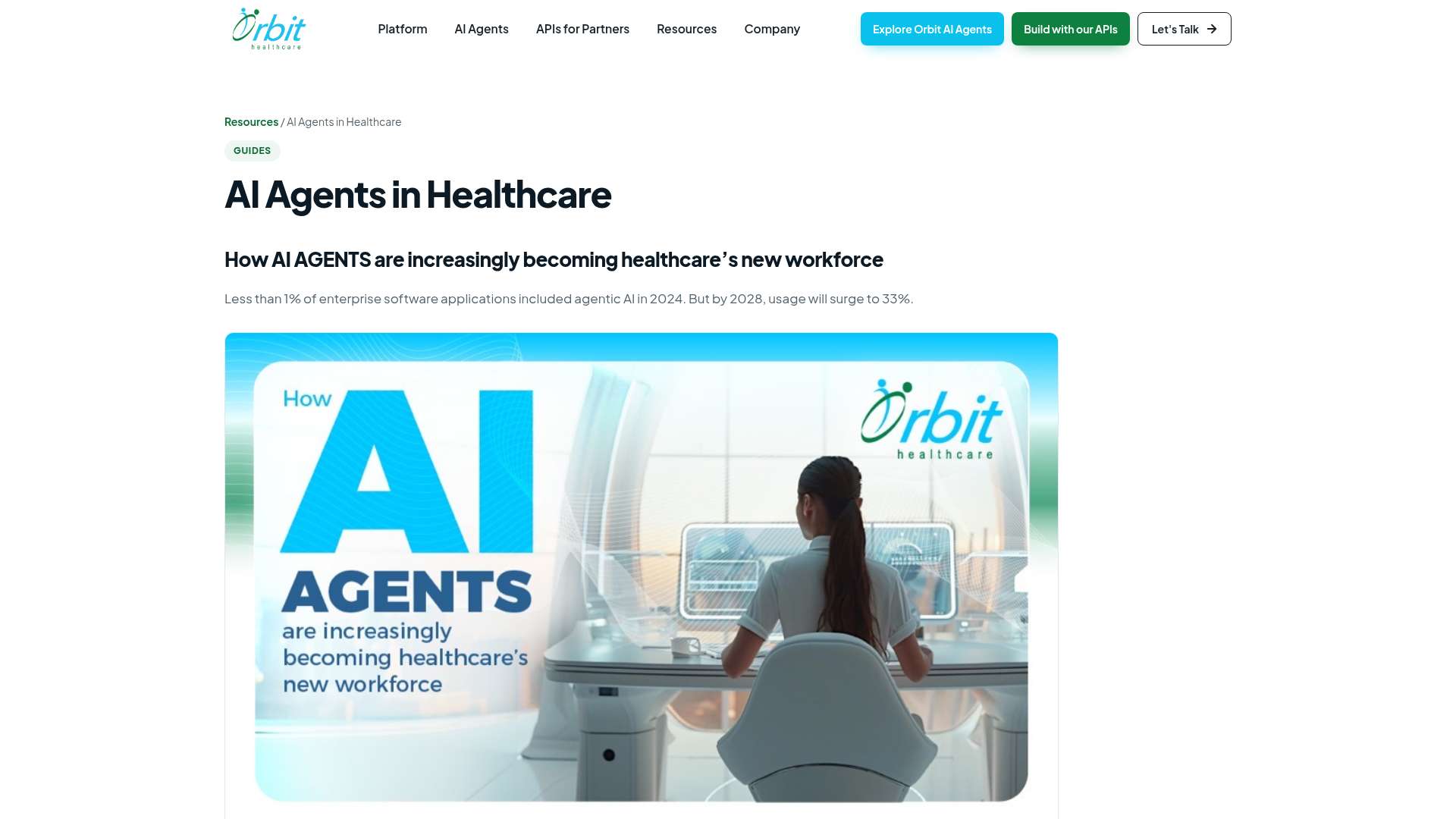
Orbit Healthcare AI Agents
Service Overview & Value Proposition
Moving beyond simple chatbots and basic automation systems, Orbit's agentic AI autonomously performs tasks, operates without human input, and continuously improves its performance based on outcomes.
The platform handles a wide range of administrative tasks including insurance capture and verification, benefits identification, out-of-pocket cost estimation, and inbound referral processing.
It significantly streamlines prior authorization workflows by automating medical necessity pre-qualification, submission, and status verification processes.
Additionally, the system manages inbound document indexing, payer correspondence letters, prescription refill request processing, and lab requisition forms for front and back-office operations.
Unlike generic public-facing AI models constrained by limited or biased data and restricted private data access, Orbit Healthcare delivers enterprise-grade security and specialized healthcare context.
As the adoption of agentic AI in enterprise software surges toward 2028, Orbit Healthcare acts as healthcare's new workforce, bridging operational gaps.
By minimizing administrative bottlenecks, the platform empowers medical organizations to reduce operational friction and redirect more time toward patient care and clinical excellence.
1. 💰 Monetization (24/30): Orbit Healthcare AI agent holds strong potential to generate approximately 3.2 million dollars in additional revenue annually by automating insurance verification and prior authorization processes. It dramatically improves cash flow by minimizing billing omissions and delays previously caused by manual tasks. However, advancing the dynamic rule-learning module is essential to handle strict and changing payer policies in real time. To further optimize revenue, predictive analytics features should be added to improve the accuracy of out-of-pocket cost estimations. Additionally, safeguards are needed to accelerate real-time data integration with insurers and prevent losses from approval delays. 2. 📉 Cost Reduction (24/30): By significantly automating repetitive back-office administration and prior authorization paperwork, it is analyzed that labor costs spent on administrative staff can be reduced by over 2.8 million dollars annually. This creates the effect of reallocating resources so medical staff and administrative personnel can focus on essential patient care rather than simple paperwork. However, consulting and maintenance costs incurred during the initial platform adoption and medical data integration phases can act as short-term financial burdens. Therefore, strategies to continuously reduce server and API call expenses through cloud infrastructure operation efficiency must be devised. Furthermore, improving the precision of self-learning agents to reduce the frequency of manual intervention during exception handling is essential. 3. ⚡ 10x Productivity (24/30): Processing times for prior authorizations and inbound referrals that previously took days or weeks have been shortened to mere minutes, boosting operational speed tenfold. By combining RAG and multi-agent architecture, it autonomously executes complex medical document indexing and payer correspondence processing. However, since patient privacy and regulatory compliance are top priorities in healthcare, potential security risks during sensitive personal data processing must be thoroughly blocked. To further enhance technical maturity, standardization efforts to secure seamless interoperability with various hospital electronic health record systems must continue. Also, system stability must be maximized by strengthening monitoring frameworks to prevent task conflicts among agents. 4. 🔍 Search & AI Optimization (7/10): Sitemaps and robots text files are properly configured, and the SEO foundation is well established around clear target keywords like healthcare AI agents. Meta tags and URL structures comply with search engine optimization guidelines, expecting excellent exposure effects when searching related industries. However, to be frequently cited as quotes in AI answer engines, in-depth whitepapers and case study contents regarding medical administration automation must be significantly expanded. Structured data markup should be applied more meticulously to enable generative AI to accurately recognize core value propositions. In addition, domain authority indexes should be raised through building backlinks with external medical technology blogs and partnership networks. 5. 📊 Overall Assessment: Orbit Healthcare is a high-value AI agent platform that accurately captures the massive market opportunity of medical administration automation. It successfully solves the chronic bottlenecks of the medical field by leveraging the characteristics of agentic AI beyond simple chatbots. However, since the healthcare domain is showing signs of intense competition with similar automation solutions, building an unrivaled technological moat is crucial. Securing large medical networks based on thorough data security and superior interface integration capabilities is the core strategy for survival. Management should not settle for short-term cost-reduction effects and must solidify market leadership through continuous learning algorithm advancement.
💬 Feedback & Reviews (0)