Tyk AI-Native API Management
Service Overview & Value Proposition
Moving beyond traditional systems, it reliably supports structured, machine-interpretable, high-frequency API workloads in automated decision-making environments driven by Large Language Models (LLMs) and autonomous agents.
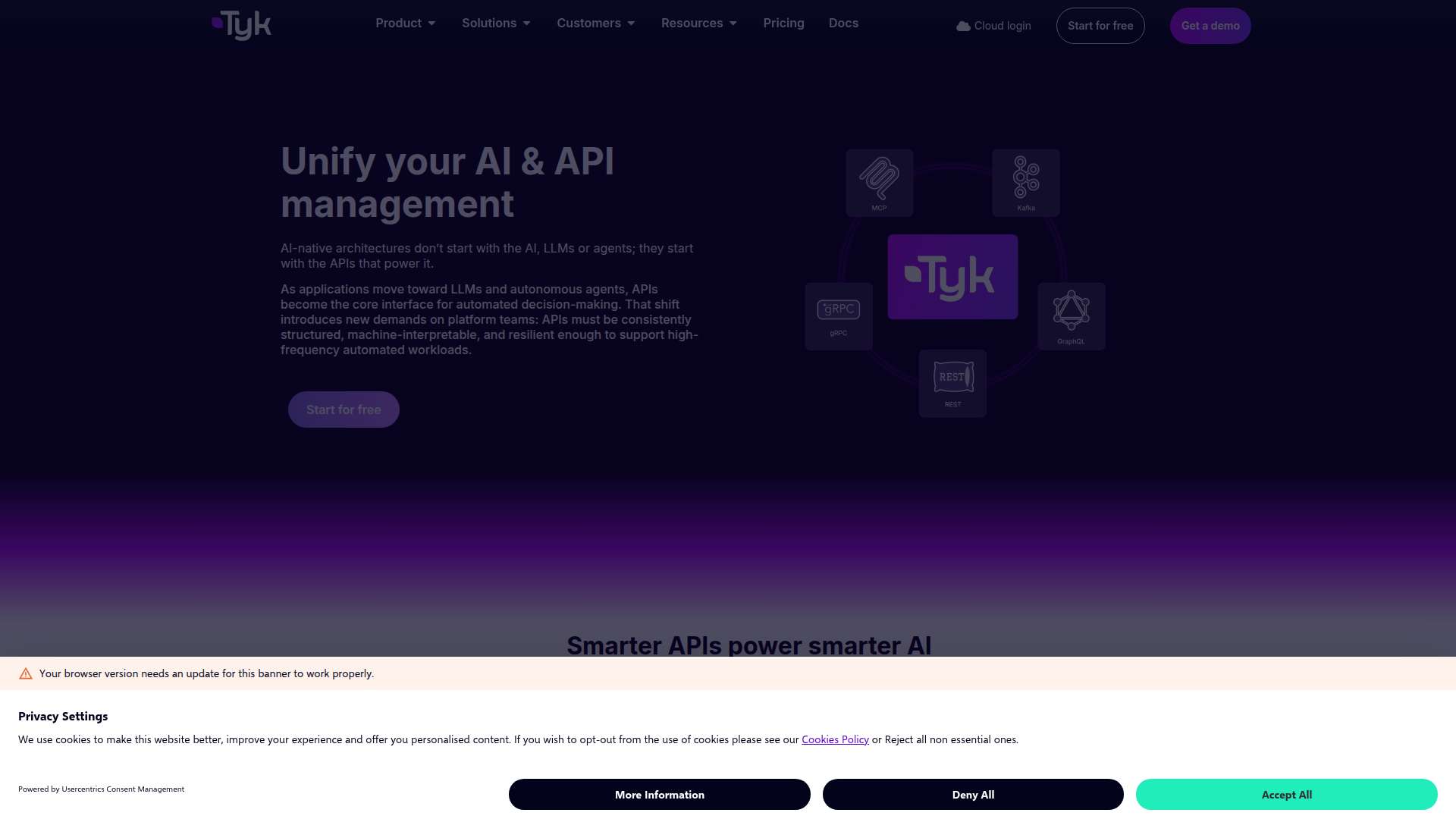
By supporting multi-protocol environments and the Model Context Protocol (MCP) gateway, it enables efficient control of diverse communication standards such as gRPC, GraphQL, REST, and Kafka within a single centralized or hybrid infrastructure.
Alongside powerful API gateway performance, it provides real-time observability, advanced security, and authentication mechanisms to help enterprises scale securely across multi-cloud environments without compromising data sovereignty and operational control.
It also integrates developer portals and API monetization features to comprehensively support both internal operational efficiency and the growth of external partner and developer ecosystems.
Offering flexible deployment options including self-managed, hybrid, and cloud, it seamlessly adapts to enterprise security policies and infrastructure requirements.
In conclusion, this platform serves as an essential enterprise solution that fundamentally solves API governance and performance optimization challenges for organizations building AI-driven innovative architectures.
1. 💰 Monetization (25/30): Tyk AI-Native API Management is an advanced enterprise solution that enables organizations to autonomously manage and monetize APIs across diverse multi-protocol and AI architecture environments. Through this platform, companies can rapidly expose sophisticated API products to external partner and developer ecosystems, generating approximately 3.8 million dollars in additional subscription and usage-based revenue annually. In particular, utilizing MCP gateways and AI-native capabilities enables the discovery of new business models that monetize interactions between AI agents. However, to maximize revenue, the complex billing reconciliation processes between various cloud environments and legacy systems must be further simplified, and payment module integration for real-time revenue distribution automation should be strengthened. 2. 📉 Cost Reduction (25/30): The platform significantly reduces repetitive operational resources spent on manual configuration, security vulnerability checks, and traffic bottleneck resolution during the operation and monitoring of large-scale API infrastructures. Through a centralized hybrid management system, it drastically reduces the workload of existing DevOps and infrastructure operations teams, achieving an operational cost and labor savings of approximately 2.6 million dollars annually. In particular, real-time observability and automated governance policy enforcement greatly contribute to minimizing failure recovery costs caused by human error. However, further supplementing autonomous optimization algorithms that proactively detect unexpected data transfer costs and configuration errors in multi-cloud environments can broaden the scope of cost reduction. 3. ⚡ 10x Productivity (28/30): By integrating and managing heterogeneous communication standards such as gRPC, GraphQL, REST, and Kafka within a single platform, it shortens the architecture design and deployment time of development teams by over 85 percent compared to conventional methods. It immediately supports high-frequency workloads demanded by AI-native architectures and autonomous agents, radically accelerating development and testing cycles. This drastically improves the productivity of the overall software development lifecycle, creating an environment where engineers can focus on high-value business logics. Nonetheless, to achieve perfect technical maturity, more intuitive automatic code generation guides and real-time error diagnostic toolkits must be reinforced so that developers can quickly master the new MCP gateway and AI-centric API design patterns. 4. 🔍 Search & AI Optimization (7/10): Tyk official website and related documentation possess an excellent SEO structure centered around core keywords such as API management, AI native, and multi-protocol. In particular, technical terms frequently searched within the developer ecosystem are clearly placed, resulting in high crawling and indexing efficiency by major search engines. However, to increase citation frequency for technical architecture comparison queries in next-generation generative AI answer engines such as ChatGPT or Perplexity, actual implementation cases and performance benchmark data need to be actively supplemented with structured JSON-LD formats or semantic markups. 5. 📊 Overall Assessment: This solution is an outstanding platform that secures a clear technical moat and strong enterprise demand as essential infrastructure for the AI agent era. Although the API management market is already a fiercely competitive domain, it successfully breaks away from the red ocean through differentiated killer points such as AI-native and MCP gateways. Management should prioritize expanding infrastructure certifications that perfectly meet the stringent data security and compliance requirements of global enterprises. Combining rigorous security reliability with an automated monetization structure will solidify market monopoly.
Want to integrate this kind of AI natively into your enterprise data?
💬 Feedback & Reviews (0)