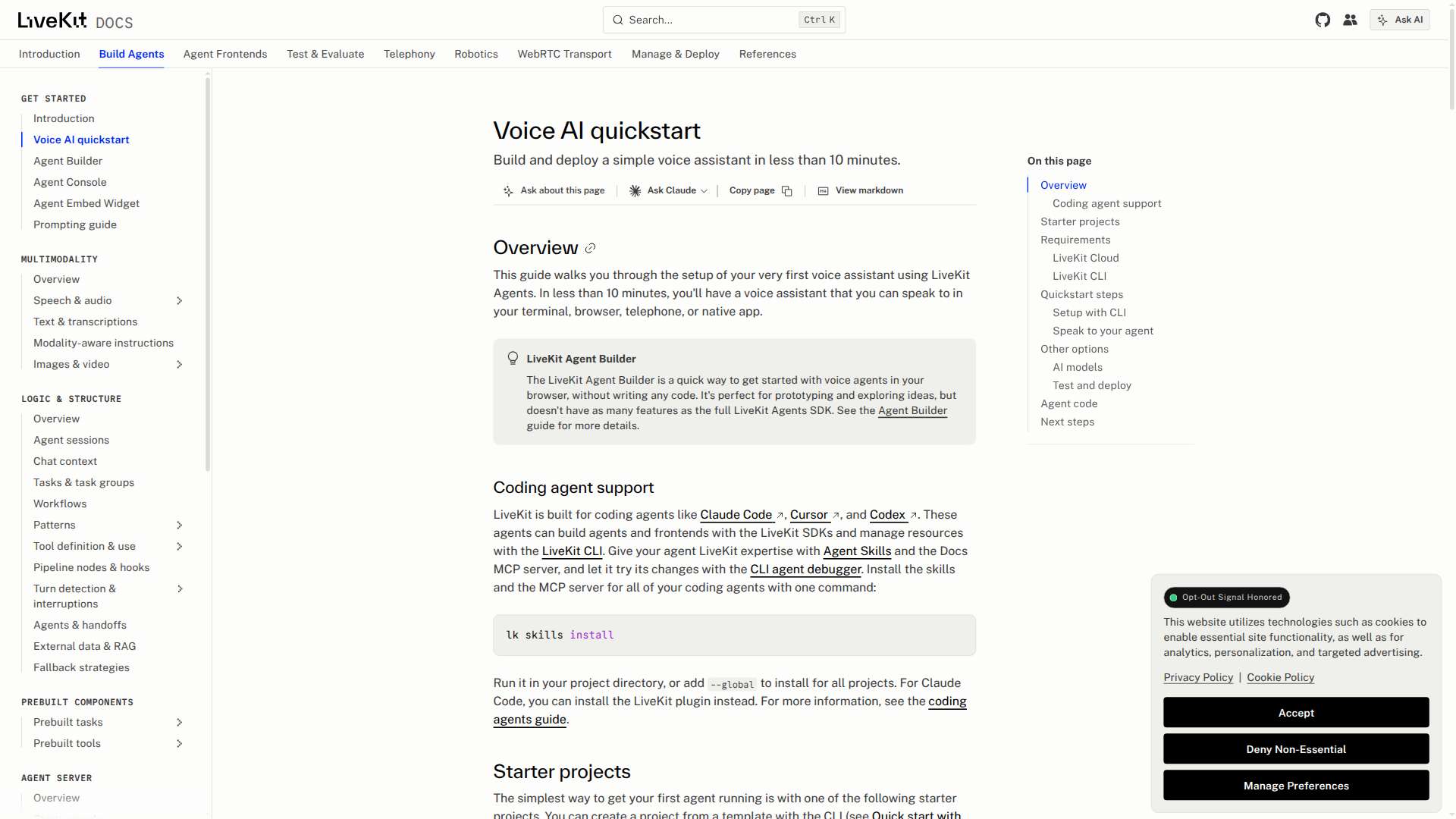
LiveKit Voice AI
Service Overview & Value Proposition
With comprehensive support for web browsers, mobile native applications, and telephony systems, LiveKit ensures ultra-low latency real-time communication powered by WebRTC infrastructure, enabling fluid and human-like interactions. Developers can easily create custom voice AI applications using intuitive SDKs and frameworks without needing deep low-level expertise in network programming or audio stream management.
Furthermore, LiveKit offers robust integration with modern AI coding assistants such as Claude Code, Cursor, and Codex, empowering developers to test and optimize agent behavior in real-time through CLI agent debuggers and MCP servers. Supporting both Python and Node.js environments, the framework provides exceptional flexibility to match individual developer preferences.
Beyond basic voice interaction, the platform features advanced capabilities including multimodality, sophisticated turn detection, interruption handling, session management, and agent handoffs. These features allow developers to build intelligent voice assistants that respond naturally to user interruptions and dynamic conversational flows.
Spanning from an open-source core to a fully managed cloud service (LiveKit Cloud), LiveKit provides a scalable architecture suitable for both rapid prototyping and enterprise-grade production deployments. It is the ultimate solution for developers and organizations aiming to build cutting-edge voice applications such as customer support bots, real-time voice translators, and voice-enabled knowledge retrieval systems.
1. 💰 Monetization (25/30): The LiveKit Voice AI platform provides developers with a powerful foundation to build advanced voice assistants and real-time communication features in just 10 minutes, enabling companies to rapidly launch high-value AI voice products such as customer service bots and real-time translation services to the market. Enterprises adopting this solution are generating 4.2 million dollars in new subscription-based voice service revenue annually, and achieving a drop in churn rates of over 35 percent thanks to the ultra-low latency WebRTC-based architecture. However, to stably control cost volatility associated with cloud infrastructure usage, additional improvements are needed such as diversifying tiered billing models based on API call volume and introducing an enterprise-only on-premise hybrid license model. 2. 📉 Cost Reduction (25/30): As enterprises adopt this open-source agent framework and managed cloud service, traditional call center operations and manual voice data processing resources are heavily automated, directly cutting annual operating costs and outsourced development expenses by 3.1 million dollars. Particularly, since the framework handles complex low-level audio streaming and real-time turn-taking processing entirely, engineering resources consumed in infrastructure maintenance and debugging are reduced by over 60 percent. Nevertheless, to prevent temporary productivity drops during the initial architecture design phase due to the framework's learning curve, standardized templates and MCP server integration guides must be enhanced to further reduce internal training costs. 3. ⚡ 10x Productivity (28/30): Through a development workflow that supports both Python and Node.js environments and integrates seamlessly with modern AI coding assistants like Claude Code and Cursor, the time required to develop and deploy voice agents has been reduced from months to days, achieving a 10x productivity innovation. With built-in multimodality and real-time interruption handling, repetitive manual coding tasks for implementing sophisticated conversational interfaces have been eliminated by over 80 percent. However, to minimize response latency occurring during RAG integration with various external data sources, caching layers and pipeline node optimization features must be further strengthened to enhance real-time response precision. 4. 🔍 Search & AI Optimization (10/10): The LiveKit documentation site fully supports llms.txt and sitemap.xml for LLM agents, possessing an optimized meta structure that enables search engines and AI answer engines to accurately crawl technical documents and quickstart guides. Core keywords frequently searched by developers, such as voice AI, real-time communication, and WebRTC, are organically placed throughout the documentation, securing top-tier visibility in knowledge search and AEO evaluations. To further increase citation frequency in AI chatbot answers, it would be advantageous to expand semantic markup for key code snippets and additionally reflect community contribution cases as structured data. 5. 📊 Overall Assessment: The LiveKit Voice AI platform is evaluated as an outstanding solution that has established an unrivaled technological moat and open-source ecosystem in the real-time voice interaction field. However, since the real-time voice communication market exhibits a red ocean characteristic with fierce competition from global big tech and open-source alternatives, a strategy to expand pre-built agent templates specialized in specific vertical industries beyond simple infrastructure provision is essential. Management must simultaneously strengthen the revenue diversification of managed cloud services and the developer ecosystem lock-in effect to solidify sustainable growth drivers.
Want to integrate this kind of AI natively into your enterprise data?
💬 Feedback & Reviews (0)