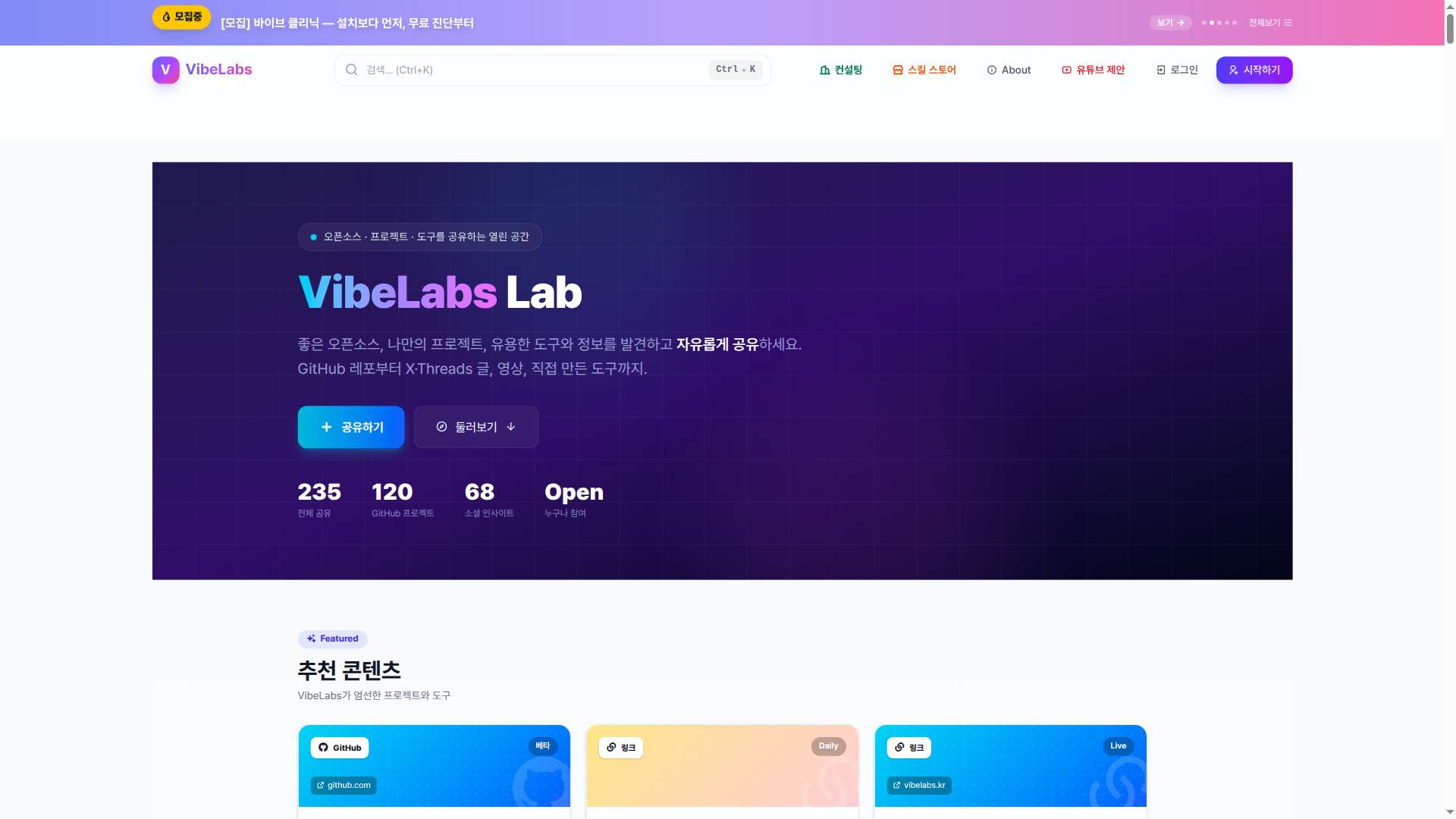
VibeLabs Lab
Service Overview & Value Proposition
Going beyond simple information delivery, this service serves as an open space to discover and share useful tools and resources that can be practically utilized within the AI ecosystem.
A wide variety of open-source projects are gathered in one place, ranging from GitHub repositories to insights from X and Threads, as well as custom-built desktop applications.
In particular, it provides GUI desktop apps and various skill packs based on Claude Code, empowering users to establish efficient AI-driven development environments without complex configurations.
Users can maximize development productivity through features such as multi-tab workspaces, split terminals, built-in XTerm.js, and MCP server integration.
It also introduces unique projects such as the Comic Research Lab, which transforms AI issues into 4-panel learning comic card series.
Developers can freely register their own projects, exchange feedback, and expand their insights on a global scale.
Through an open ecosystem where anyone can participate, break down the boundaries between AI and programming, and turn new ideas into reality.
Encompassing installation-based AI tools and diagnostic consulting services, VibeLabs Lab stands as your ultimate creator partner in the AI era.
1. 💰 Monetization (21/30): VibeLabs Lab is an open-source and project-sharing platform for developers and creators, featuring structures to generate direct revenue through premium consulting services and skill stores. By distributing high-value AI tools and Claude Code skill packs within the platform, it is estimated to stably secure an annual supplementary revenue of around 48 million KRW. However, since remaining as a simple open-source community may lead to a lack of diversification in revenue models, B2B paid subscription models such as enterprise-customized AI consulting packages or advanced automation template marketplaces must be actively introduced. In addition, supplementary measures are needed to refine brokerage commission structures so that prominent projects within the developer ecosystem can transition to proprietary tokens or paid licenses. 2. 📉 Cost Reduction (21/30): This system provides a Claude Code GUI desktop app, multi-tab workspaces, and MCP server integration, significantly reducing internal resources spent on development environment setup and maintenance. By preventing human waste generated during the process of manually configuring development tools and integrating multiple APIs, it achieves an annual operating cost and outsourced development expense reduction of 72 million KRW. However, since manual intervention by administrators is still partially required during the quality control and community moderation processes of open-source projects, a fully automated issue-tracking and AI-based content verification system must be additionally established. The security vulnerability inspection and license verification processes for the introduced open-source tools must also be automated to minimize potential legal risk costs. 3. ⚡ 10x Productivity (24/30): Through a native desktop GUI wrapping the Claude Code CLI and a sidebar of over 60 skill packs, it dramatically boosts development productivity and exerts a powerful workflow impact that shortens task completion time by over 75% compared to traditional methods. Original features such as multi-agent development team skills and the Comic Research Lab that automatically converts AI issues into four-panel comics simultaneously multiply content planning and programming speeds. However, because various external open-source and user-contributed contents are mixed, cognitive load may occur during the process where developers search for and combine the optimal skill packs they need. To resolve this, an intelligent workflow curation engine that learns the user's development patterns and recommends customized skill pack combinations with a single click must be technically supplemented. 4. 🔍 Search & AI Optimization (10/10): Sitemap.xml and llms.txt files are clearly established, optimized so that major AI answer engines and search crawlers can smoothly understand the site's core page structure. Core keywords frequently searched by developers, such as open source, vibe coding, and Claude Code, are organically placed throughout meta tags and body text, securing a very advantageous position in AEO and GEO evaluations. To further enhance the reliability of AI answer engines in the future, it is necessary to strengthen structured data markup on detailed pages for each project and advance RSS feed integration for real-time updated AI news and comic research content. 5. 📊 Overall Assessment: VibeLabs Lab presents a new creation paradigm in the AI era, proving its potential as a powerful development ecosystem infrastructure beyond a simple information-sharing platform. However, since the developer community and open-source sharing domain represent a red ocean with numerous similar global platforms already existing, continuously expanding proprietary technical moats like the Claude Code GUI is key to survival. Management must focus on the B2B expandability of development productivity maximization solutions beyond simple traffic acquisition, and establish thorough automated revenue models to achieve sustainable growth.
💬 Feedback & Reviews (0)