Insilicogen AI Bio Solution
Service Overview & Value Proposition
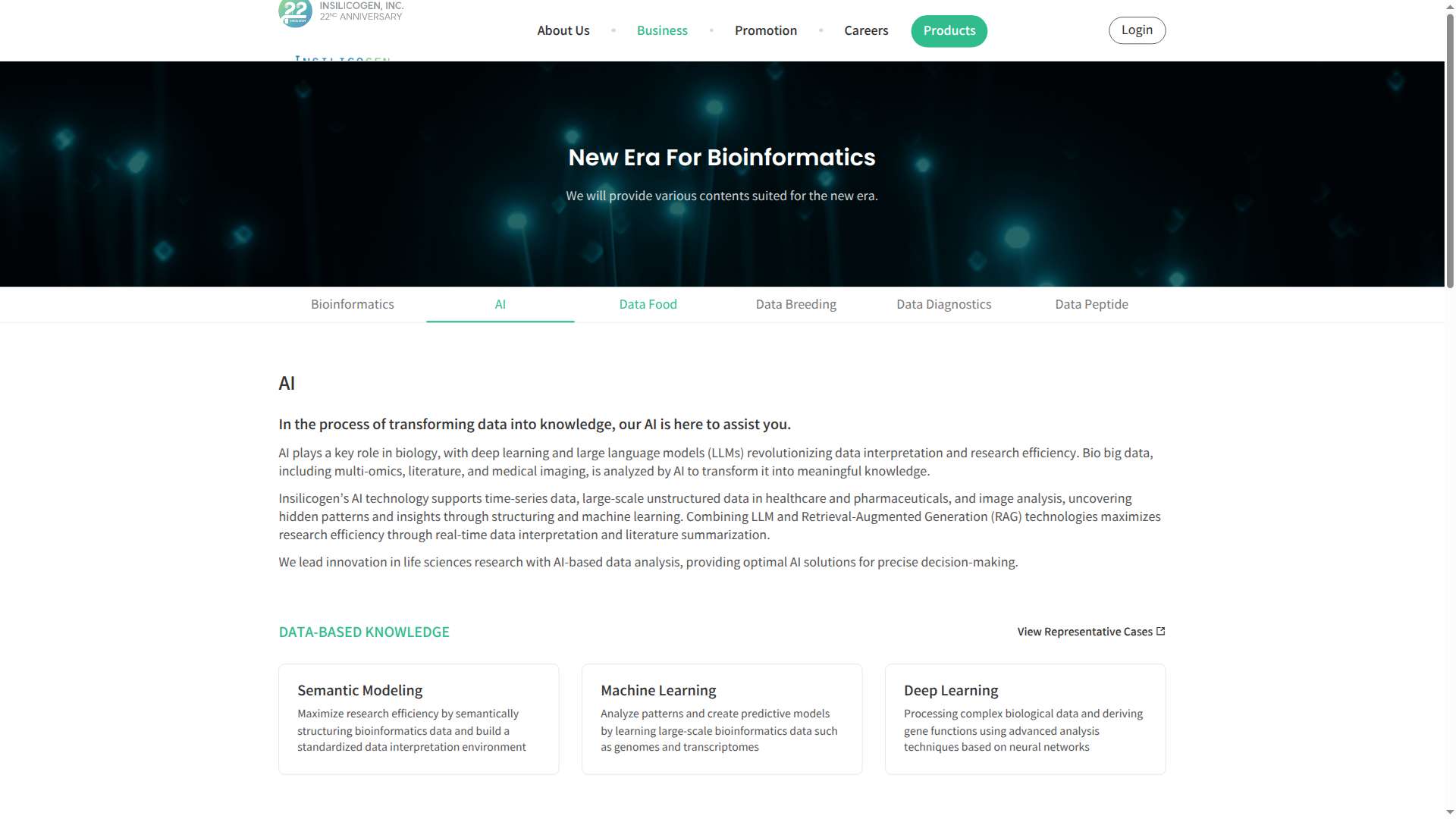
Designed to maximize data interpretation efficiency in modern life sciences research, it precisely analyzes large-scale unstructured and time-series data in healthcare and pharmaceuticals.
By supporting medical image analysis, literature summarization, and real-time data interpretation, it empowers researchers to swiftly and accurately uncover hidden patterns and insights.
Through semantic modeling techniques, it structures bioinformatics data within a standardized environment, drastically enhancing research efficiency.
It applies machine learning algorithms to build robust and sophisticated predictive models based on large-scale biological data such as genomes and transcriptomes.
Advanced deep learning techniques are employed to process complex biological data and derive gene functions through neural network-based analyses.
Combining Retrieval-Augmented Generation (RAG) technology, it delivers real-time data interpretation and literature synthesis to support precise decision-making.
It accelerates value creation across the pharmaceutical and biotechnology sectors by pioneering AI-driven data analysis that shifts the paradigm of life sciences research.
Addressing complex data challenges in precision medicine and drug discovery, it serves as a trusted partner delivering optimal AI solutions.
Insilicogen continuously expands and provides diverse AI contents and professional analytical environments to lead the new era of bioinformatics.
1. 💰 Monetization (25/30): Insilicogen AI Bio Solution generates substantial added value by accelerating drug discovery processes through precision analysis of multi-omics and healthcare big data. The knowledge transformation framework combining deep learning and large language models can drive additional revenue of 4.2 million dollars annually through licensing and customized data analysis consulting with pharmaceutical companies and bio-labs. In particular, real-time literature analysis and drug target discovery automation via RAG technology operate as a powerful monetization model that shortens research lead times and advances commercialization schedules. However, an entry barrier-lowering pricing structure that targets small and medium-sized bio-ventures by upgrading a general subscription model must be introduced. In addition, API-based external pharma integration services should be expanded to actively establish a platform ecosystem commission model beyond simple data analysis outsourcing. 2. 📉 Cost Reduction (24/30): Compared to conventional research methods that manually process large-scale biological unstructured data and time-series data, this platform drastically lowers data refinement and preprocessing costs by applying semantic modeling and machine learning algorithms. By automating manual data interpretation and literature review processes based on human labor, it is evaluated that internal personnel expenses and outsourced analysis costs amounting to 2.8 million dollars annually can be reduced. Repetitive resources required for complex gene function analysis and medical imaging analysis are minimized, maximizing overall operational efficiency. However, since the maintenance cost of high-performance cloud computing for initial deep learning infrastructure construction and large-scale medical big data training is considerable, resource optimization scheduling algorithms must be introduced. Furthermore, a complementary measure to continuously lower infrastructure maintenance costs by running a parallel process of fine-tuning lightweight models specialized in proprietary domains to reduce LLM token costs is essential. 3. ⚡ 10x Productivity (26/30): Semantic modeling and deep learning neural network-based gene function analysis workflows provide a 10x productivity innovation that completes biological data interpretation tasks that previously took months within just a few hours. Real-time literature summary agents combined with RAG technology empower researchers to instantly extract key insights from vast numbers of papers, dramatically boosting information search speeds. Genomic and transcriptomic predictive modeling through machine learning models drastically reduces trial and error for human researchers, simultaneously multiplying the accuracy and success rate of research and development. However, human verification loops are still required at certain stages to prevent hallucination or misrecognition that may occur during correlation analysis among complex multi-omics data. Therefore, the cross-validation inspection system among autonomous agents must be upgraded to evolve into a fully automated pipeline that minimizes human intervention. 4. 🔍 Search & AI Optimization (7/10): The website structure and provided metadata well reflect core keywords in bioinformatics and deep learning, providing an appropriate environment for search engine crawlers to recognize key technical elements. Structured data markup needs to be expanded so that public AI answer engines can accurately grasp the expertise of this solution for queries related to life sciences and medical AI. In particular, long-tail keyword optimization related to specialized academic terms and RAG-based solutions primarily searched by global pharmaceutical and biotech researchers must be further reinforced. A strategic approach is required to maximize the indexing efficiency of AI crawlers by deeply placing technical white papers and research cases within the website in an open-access format. 5. 📊 Overall Assessment: This solution possesses a high technical moat as an authentic bioinformatics AI platform that combines advanced bio-domain knowledge and deep learning, moving beyond simple chatbots or wrappers. However, since the pharmaceutical and biotech domain is a highly competitive red ocean area dominated by global big tech and specialized AI startups, killer unique functions such as specific rare disease target discovery or customized genomic interpretation must be continuously strengthened beyond general analysis. Management must completely eliminate repetitive tasks of researchers through an advanced multi-agent collaboration system and promptly secure clinical data-linked certifications to verify the reliability and transparency of the platform. Through the combination of a thorough data security system and a proprietary domain-specific model, irreplaceable AI leadership can be solidly established in the global life sciences market.
💬 Feedback & Reviews (0)