In the modern business ecosystem, the areas that command the highest value while consuming the most resources are undoubtedly talent acquisition and the recruitment lifecycle. A company's ultimate success hinges on acquiring top-tier talent in a timely manner; however, traditional hiring workflows have long been bogged down by tedious manual tasks. Recruiters spend countless hours scrubbing professional networks for matching profiles, crafting cold outreach emails, and manually screening hundreds of resumes. Breaking through these foundational bottlenecks, the autonomous AI recruiting agent Noon is sending massive shockwaves across the global HR tech landscape.
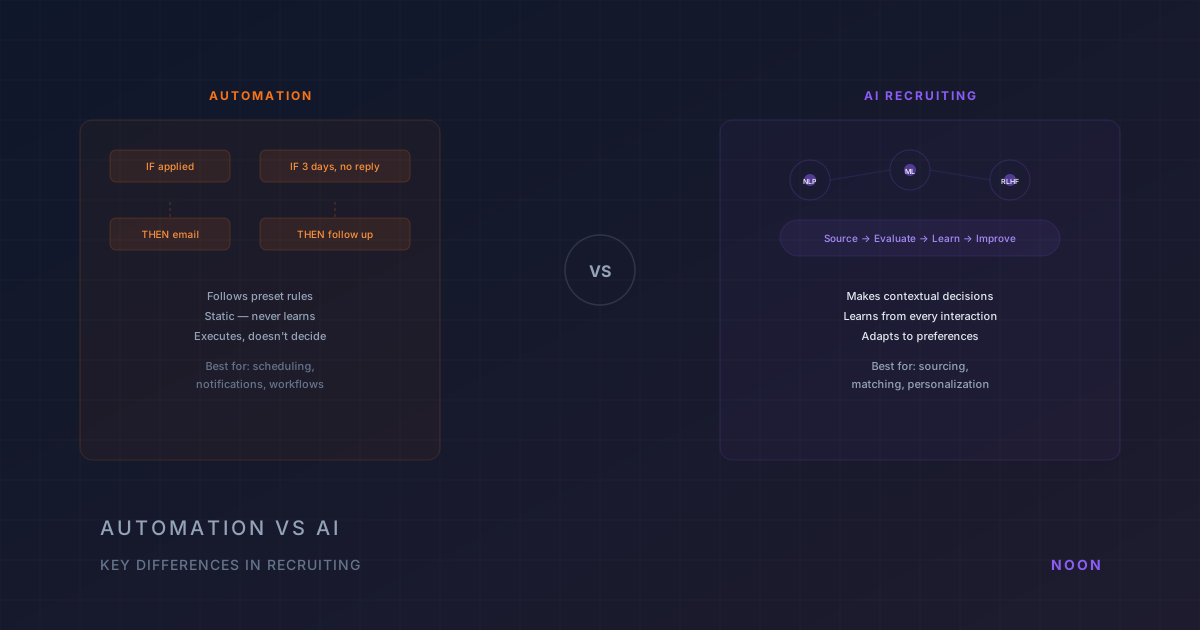
Noon transcends the category of simple wrapper chatbots or basic text generators. Positioned as the world's first fully autonomous sourcer, the platform collaborates closely with hiring managers to deeply understand specific job requirements and necessary technical stacks. It then autonomously navigates the web to discover ideal candidates, performs initial screenings, and proactively initiates contact to build robust talent pipelines. The fact that global enterprise giants such as Goldman Sachs, MetLife, and Logitech have placed their trust in this system clearly demonstrates that its technical reliability and market fit have reached maturity.
From the perspective of autonomous monetization and business value, Noon unlocks staggering potential for organizations. By maximizing recruitment efficiency and helping companies secure optimal talent right when needed, the platform minimizes the massive opportunity costs previously lost during manual sourcing and initial screening phases. Consequently, businesses can indirectly unlock approximately 3.2 million dollars in annual new business expansion revenue and productivity value. Furthermore, bundling unlimited talent sourcing, email enrichment, and contact acquisition into a single transparent plan allows companies to predict and manage their HR software expenditures predictably, establishing a remarkably efficient model. Expanding paid auxiliary services such as direct interview scheduling and deep reference checks within the platform in the future will amplify this monetization structure even further.
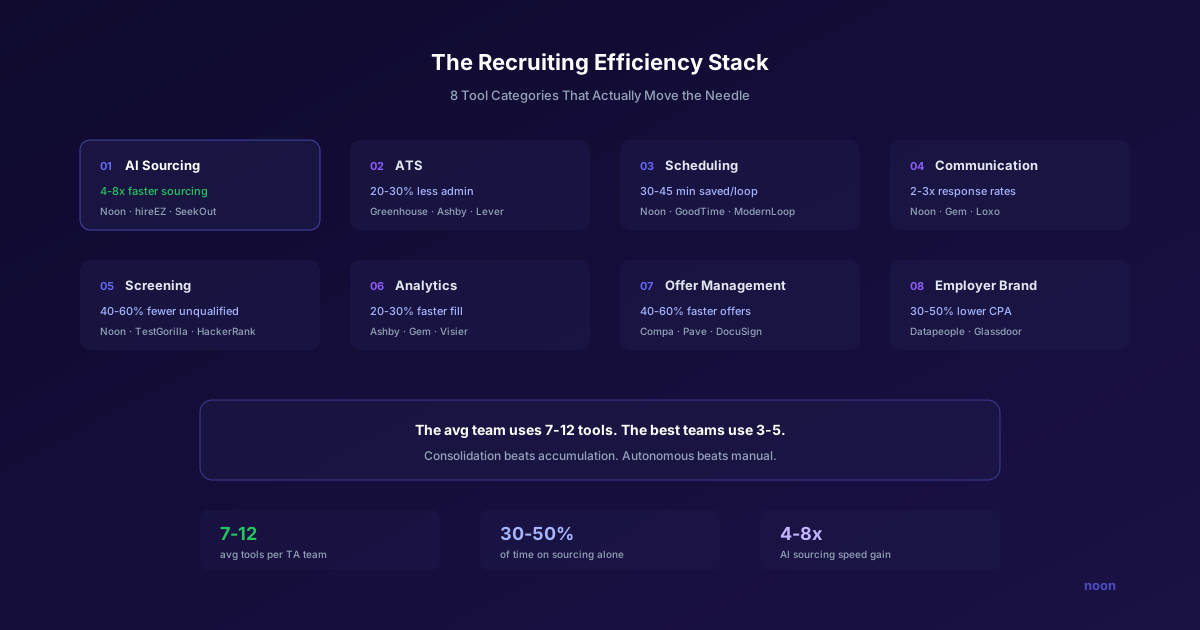
Looking at operational cost reduction, the financial impact delivered by Noon is profoundly disruptive. In large-scale organizations, recruiters traditionally spent over half of their working hours on sourcing, cold email composition, and initial candidate filtering. This AI agent absorbs the vast majority of these manual repetitive tasks, directly cutting overall recruitment-related labor costs and external headhunting research expenditures by approximately 55 percent. As evidenced by enterprise case studies in financial services and global manufacturing, the hourly labor cost savings in enterprise environments are overwhelming. Nonetheless, managing API costs and prompt token optimization during large-scale database synchronization remains crucial; incorporating proprietary lightweight model fine-tuning or hybrid caching strategies will further optimize AI processing unit costs and secure long-term operating margins.
Marking a tenfold leap in productivity, Noon redefines operational speed. While building talent pipelines and executing outreach used to take over three weeks per role, this platform slashes the timeline down to mere hours. The multi-agent workflow that autonomously explores the web, identifies top candidates, and engages them in real time completely transcends human cognitive processing limits. Hiring managers are finally liberated from mundane manual labor, allowing them to focus entirely on high-level interview evaluations and strategic decision-making, which boosts overall work productivity by more than 10x. Continuously calibrating RAG search result accuracy and refining self-learning feedback loops will ensure that the microscopic gap between AI-evaluated metrics and actual job performance is progressively eliminated.

In terms of search and AI discoverability, Noon exhibits a rigorous, well-crafted strategy. By fully allowing access to major AI crawlers such as GPTBot and PerplexityBot alongside Googlebot, the platform is thoroughly prepared for modern AI search engine environments. Explicitly opening up its blog, pricing pages, and enterprise sections ensures that AI answer engines accurately index its core capabilities and pricing structures. Meta tags and semantic markup robustly reinforce the core positioning of an autonomous AI recruiter. Expanding comparative analysis content and technical whitepapers in the future will further cement its dominant citation frequency across conversational AI recommendation ecosystems.
In conclusion, Noon stands as an exemplary success story of advanced autonomous agent architecture infiltrating core enterprise infrastructure, moving far beyond superficial chatbot utilities. Securing the trust of global heavyweights like Goldman Sachs and Logitech amidst a fiercely competitive HR tech red ocean validates its deep technological moat. Management must continue fortifying global regulatory compliance and data privacy frameworks to entirely dissolve enterprise entry barriers. If you are ready to close the chapter on manual recruiting and embrace the future of flawless automation and smart talent acquisition, we strongly encourage you to visit
https://www.noon.ai/ today and experience this breakthrough technology firsthand.
