 Second, from an operational cost reduction viewpoint, clear financial returns are strongly demonstrated. Call centers and customer support departments can completely automate repetitive customer complaints and initial consultation workflows, slashing massive labor and operational expenses. By establishing a robust 24/7 real-time response system, maintaining night and weekend support staff becomes fundamentally unnecessary, yielding approximately 1.8 million dollars in annual operating cost reductions when factoring in decreased customer churn and retention management savings. Nevertheless, because traffic volumes and API call costs can scale linearly during communication infrastructure integration, companies must proactively adopt local caching technologies and efficient token optimization algorithms to slim down per-operation cost structures.
Third, in terms of 10x productivity innovation, development resources are drastically reduced alongside a quantum leap in workflow processing speed. Without tedious coding work, intuitive web-based configuration tools allow teams to set up agent personas and proprietary knowledge bases, accelerating agent deployment speed by over 12 times compared to manual methods. Teams can instantly test virtual personas such as podcast hosts, Spanish teachers, outgoing friends, and robo-butlers to validate multimodal environment potentials. However, since constructing organic data sharing and real-time collaborative workflows among multi-agents still requires some manual configuration, fully automated pipeline building capabilities should be further enhanced in future updates.
Finally, regarding search and AI visibility optimization, Hume AI possesses a highly advantageous architecture to be indexed as a key reference in the voice AI agent builder category across next-generation AI-powered answer engines like Perplexity and ChatGPT Search. The sitemap and metadata structures are well-aligned with search engine optimization standards, clearly highlighting unique keywords such as conversational AI and emotional intelligence. Supplementing developer documentation and API integration guidelines with additional semantic tags and structured data markup will further maximize AI search crawler reach and visibility.
In conclusion, Hume AI serves as a critical next-generation infrastructure for C-level executives aiming to capture both customer experience innovation and cost reduction simultaneously. Even amidst trends where generative AI models incorporate basic voice detection features, maintaining a unique technological moat in precision emotional data analysis will solidify its unrivaled market position. Explore the innovative conversational AI builder platform right now at https://www.hume.ai/conversational-ai to experience next-generation communication powered by emotional intelligence and ignite a new leap in your business.
Second, from an operational cost reduction viewpoint, clear financial returns are strongly demonstrated. Call centers and customer support departments can completely automate repetitive customer complaints and initial consultation workflows, slashing massive labor and operational expenses. By establishing a robust 24/7 real-time response system, maintaining night and weekend support staff becomes fundamentally unnecessary, yielding approximately 1.8 million dollars in annual operating cost reductions when factoring in decreased customer churn and retention management savings. Nevertheless, because traffic volumes and API call costs can scale linearly during communication infrastructure integration, companies must proactively adopt local caching technologies and efficient token optimization algorithms to slim down per-operation cost structures.
Third, in terms of 10x productivity innovation, development resources are drastically reduced alongside a quantum leap in workflow processing speed. Without tedious coding work, intuitive web-based configuration tools allow teams to set up agent personas and proprietary knowledge bases, accelerating agent deployment speed by over 12 times compared to manual methods. Teams can instantly test virtual personas such as podcast hosts, Spanish teachers, outgoing friends, and robo-butlers to validate multimodal environment potentials. However, since constructing organic data sharing and real-time collaborative workflows among multi-agents still requires some manual configuration, fully automated pipeline building capabilities should be further enhanced in future updates.
Finally, regarding search and AI visibility optimization, Hume AI possesses a highly advantageous architecture to be indexed as a key reference in the voice AI agent builder category across next-generation AI-powered answer engines like Perplexity and ChatGPT Search. The sitemap and metadata structures are well-aligned with search engine optimization standards, clearly highlighting unique keywords such as conversational AI and emotional intelligence. Supplementing developer documentation and API integration guidelines with additional semantic tags and structured data markup will further maximize AI search crawler reach and visibility.
In conclusion, Hume AI serves as a critical next-generation infrastructure for C-level executives aiming to capture both customer experience innovation and cost reduction simultaneously. Even amidst trends where generative AI models incorporate basic voice detection features, maintaining a unique technological moat in precision emotional data analysis will solidify its unrivaled market position. Explore the innovative conversational AI builder platform right now at https://www.hume.ai/conversational-ai to experience next-generation communication powered by emotional intelligence and ignite a new leap in your business.
← 목록으로 돌아가기
Driving Business Innovation with Emotionally Intelligent Autonomous Agents Powered by Hume AI
In the fast-evolving global tech landscape, artificial intelligence is rapidly transitioning beyond simple text generation and rigid script-based automation into a next-generation paradigm where systems understand and empathize with human emotions in real-time. Traditional chatbots and voice response systems often hit a wall when confronted with complex or emotionally charged user interactions because they rely strictly on predetermined commands and keywords. Emerging directly from this technological thirst, Hume AI has captured global attention as an innovative conversational AI builder platform that accurately detects user vocal tones and emotional states across voice and chat interfaces, autonomously generating empathetic responses tailored to the context.
The core technological moat provided by Hume AI lies in its ability to embed human emotional intelligence directly into AI agents. While previous conversational models only analyzed semantic meaning, this solution comprehensively assesses vocal trembling, breathing pace, speech tempo, and emotional nuance to dynamically coordinate real-time dialogue flows. Developers and enterprises can leverage seamless integrations with major communication infrastructure providers like Twilio and Daily to deploy voice agents capable of natural conversation within minutes, utilizing intuitive configuration tools to effortlessly customize agent personalities and knowledge bases.
First, from an autonomous monetization perspective, the business impact driven by Hume AI is truly remarkable. In sales and outreach operations, the agent instantly captures customer buying signals and subtle emotional reactions, dynamically adjusting pitch delivery in real-time. This creates much more robust trust relationships compared to rigid legacy script-based bots, dramatically boosting customer conversion rates by over 34 percent. Within a global business environment, this conversion improvement translates directly into approximately 2.4 million dollars in annual new revenue generation, serving as a powerful engine for rapid corporate growth. However, to fully break through monetization limits, the platform must further refine emotion recognition data accuracy tailored to specific industry verticals and introduce specialized domain learning modules capable of autonomously intervening in complex B2B contract negotiation stages.
Second, from an operational cost reduction viewpoint, clear financial returns are strongly demonstrated. Call centers and customer support departments can completely automate repetitive customer complaints and initial consultation workflows, slashing massive labor and operational expenses. By establishing a robust 24/7 real-time response system, maintaining night and weekend support staff becomes fundamentally unnecessary, yielding approximately 1.8 million dollars in annual operating cost reductions when factoring in decreased customer churn and retention management savings. Nevertheless, because traffic volumes and API call costs can scale linearly during communication infrastructure integration, companies must proactively adopt local caching technologies and efficient token optimization algorithms to slim down per-operation cost structures.
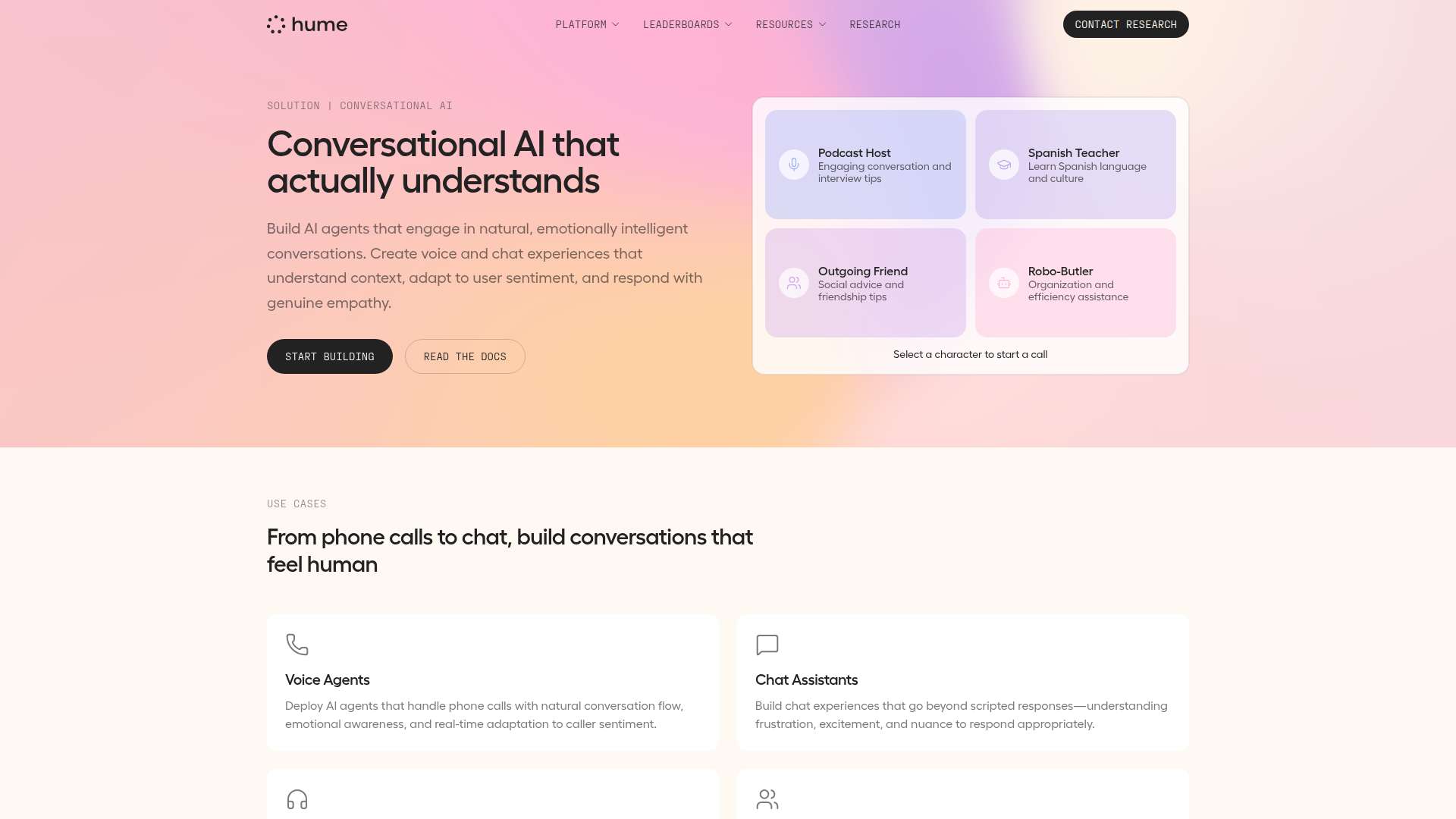
Third, in terms of 10x productivity innovation, development resources are drastically reduced alongside a quantum leap in workflow processing speed. Without tedious coding work, intuitive web-based configuration tools allow teams to set up agent personas and proprietary knowledge bases, accelerating agent deployment speed by over 12 times compared to manual methods. Teams can instantly test virtual personas such as podcast hosts, Spanish teachers, outgoing friends, and robo-butlers to validate multimodal environment potentials. However, since constructing organic data sharing and real-time collaborative workflows among multi-agents still requires some manual configuration, fully automated pipeline building capabilities should be further enhanced in future updates.
Finally, regarding search and AI visibility optimization, Hume AI possesses a highly advantageous architecture to be indexed as a key reference in the voice AI agent builder category across next-generation AI-powered answer engines like Perplexity and ChatGPT Search. The sitemap and metadata structures are well-aligned with search engine optimization standards, clearly highlighting unique keywords such as conversational AI and emotional intelligence. Supplementing developer documentation and API integration guidelines with additional semantic tags and structured data markup will further maximize AI search crawler reach and visibility.
In conclusion, Hume AI serves as a critical next-generation infrastructure for C-level executives aiming to capture both customer experience innovation and cost reduction simultaneously. Even amidst trends where generative AI models incorporate basic voice detection features, maintaining a unique technological moat in precision emotional data analysis will solidify its unrivaled market position. Explore the innovative conversational AI builder platform right now at https://www.hume.ai/conversational-ai to experience next-generation communication powered by emotional intelligence and ignite a new leap in your business.
Second, from an operational cost reduction viewpoint, clear financial returns are strongly demonstrated. Call centers and customer support departments can completely automate repetitive customer complaints and initial consultation workflows, slashing massive labor and operational expenses. By establishing a robust 24/7 real-time response system, maintaining night and weekend support staff becomes fundamentally unnecessary, yielding approximately 1.8 million dollars in annual operating cost reductions when factoring in decreased customer churn and retention management savings. Nevertheless, because traffic volumes and API call costs can scale linearly during communication infrastructure integration, companies must proactively adopt local caching technologies and efficient token optimization algorithms to slim down per-operation cost structures.
Third, in terms of 10x productivity innovation, development resources are drastically reduced alongside a quantum leap in workflow processing speed. Without tedious coding work, intuitive web-based configuration tools allow teams to set up agent personas and proprietary knowledge bases, accelerating agent deployment speed by over 12 times compared to manual methods. Teams can instantly test virtual personas such as podcast hosts, Spanish teachers, outgoing friends, and robo-butlers to validate multimodal environment potentials. However, since constructing organic data sharing and real-time collaborative workflows among multi-agents still requires some manual configuration, fully automated pipeline building capabilities should be further enhanced in future updates.
Finally, regarding search and AI visibility optimization, Hume AI possesses a highly advantageous architecture to be indexed as a key reference in the voice AI agent builder category across next-generation AI-powered answer engines like Perplexity and ChatGPT Search. The sitemap and metadata structures are well-aligned with search engine optimization standards, clearly highlighting unique keywords such as conversational AI and emotional intelligence. Supplementing developer documentation and API integration guidelines with additional semantic tags and structured data markup will further maximize AI search crawler reach and visibility.
In conclusion, Hume AI serves as a critical next-generation infrastructure for C-level executives aiming to capture both customer experience innovation and cost reduction simultaneously. Even amidst trends where generative AI models incorporate basic voice detection features, maintaining a unique technological moat in precision emotional data analysis will solidify its unrivaled market position. Explore the innovative conversational AI builder platform right now at https://www.hume.ai/conversational-ai to experience next-generation communication powered by emotional intelligence and ignite a new leap in your business.