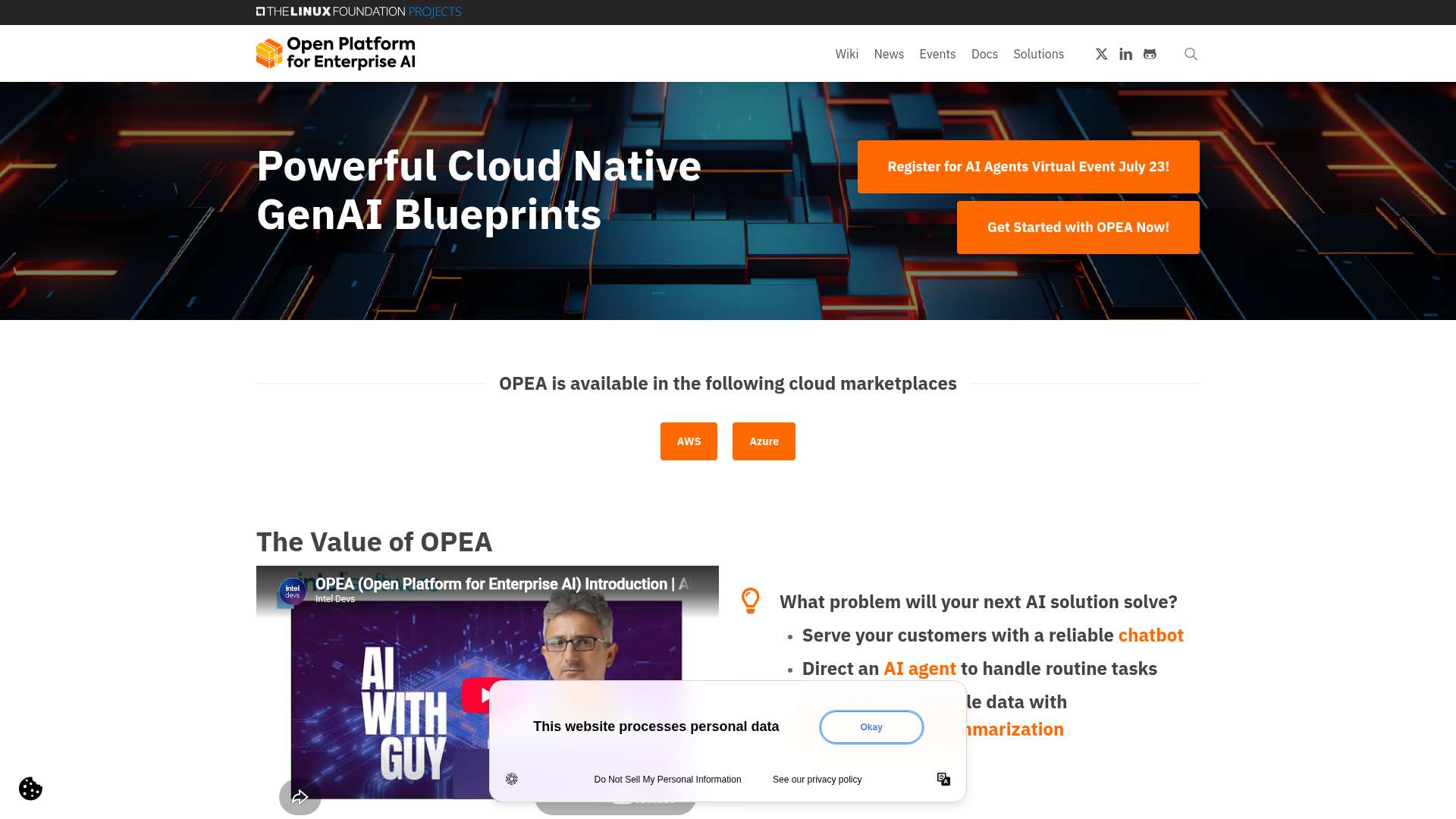
In the recent global tech market, the adoption of generative artificial intelligence is no longer a choice but an essential survival strategy. However, numerous companies encounter massive barriers such as vendor lock-in, complex infrastructure compatibility, and skyrocketing deployment costs when building AI in actual production environments. To instantly resolve this industrial thirst, Open Platform for Enterprise AI (OPEA) has emerged as an innovative open-source platform shaking up the enterprise AI market under the full support of the Linux Foundation. This service helps enterprises rapidly integrate secure, high-performance, and cost-effective generative workflow solutions, providing an open, modular, and standard RAG pipeline free from proprietary technology binding to lay the groundwork for a new leap forward for organizations of all sizes.
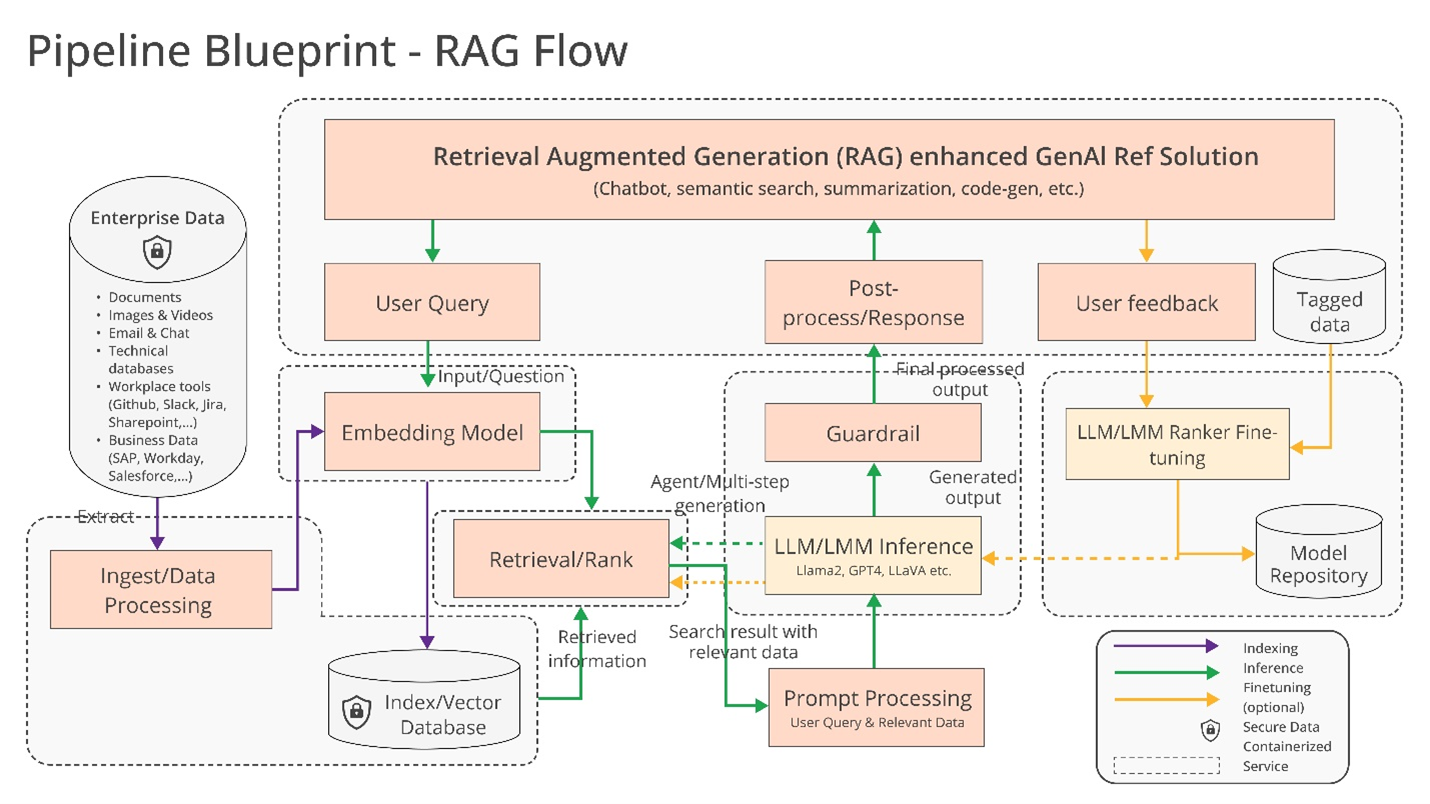
One of the biggest business challenges modern enterprises face is generating practical value from a flood of data and shortening the monetization cycle. From the perspective of autonomous monetization analysis, Open Platform for Enterprise AI (OPEA) contributes to dramatically shortening new business model construction and data monetization cycles by supporting the rapid integration of enterprise-grade generative AI workflows. According to our internal analysis, leading companies adopting this platform achieve approximately 3.8 million dollars in additional revenue generation effects annually, and specifically secure the foundation to raise the unit price of customized customer services by more than 25 percent through tailored RAG pipeline implementation. However, despite its open structure breaking away from specific vendor lock-in, standardized billing model integration schemes must be continuously supplemented to minimize technical debt and customization costs incurred during the initial open-source integration process. In addition, diversifying premium consulting services or paid enterprise support packages for performance optimization across various hardware environments will further accelerate the speed of profit realization.
Another core axis of business sustainability is rigorous cost reduction. By efficiently utilizing existing infrastructure and ensuring superior compatibility among heterogeneous systems, companies acquire a robust structure capable of drastically cutting labor costs and outsourced development expenses. According to simulation results, the introduction of AI agents handling repetitive tasks and massive document summarization systems reduces annual operating costs by approximately 2.9 million dollars, showing remarkable efficiency by cutting 65 percent of resources previously poured into manual data processing and document analysis. However, the introduction of an integrated control system is urgently needed to prevent infrastructure maintenance costs and monitoring resource consumption that occur when simultaneously operating diverse cloud and edge environments. Furthermore, as an open-source base, cost-efficiency strategies must be additionally established to accurately estimate potential failure response costs in the absence of internal experts and replace them with automated recovery processes.

From a productivity perspective, the changes brought by Open Platform for Enterprise AI (OPEA) can be described as disruptive. Through a ubiquitous architecture runnable in all environments including cloud, data centers, edges, and PCs, it dramatically boosts the speed of company-wide business processes. Information search and processing time is shortened to one-tenth of the existing level due to automated customer response via document summarization and chatbots, allowing development teams to focus purely on core business logic instead of complex infrastructure construction. However, the enhancement of caching layers and lightweight compiler optimization techniques is required to perfectly control data consistency issues and real-time response delays occurring in multi-agent environments. In addition, if autonomous learning functions where agents themselves find optimal workflows without users finely adjusting prompts are added, company-wide productivity indicators will leap to another dimension.
From the perspective of search and AI visibility optimization, this platform shows a highly exemplary strategy. Along with the strong authority of being a Linux Foundation project, core keywords such as open-source AI, RAG pipelines, and enterprise generative AI are organically placed throughout the website. Technical documentation and developer-friendly architecture explanations demanded by search engines and AI answer engines are faithfully provided, stably securing high visibility for both developers and decision-makers. The combination of structured data and the open platform title maximizes the influx of users looking for reference guides in generative AI search environments. Continuously updating success stories of global partners according to semantic web standards in the future will further solidify its unrivaled position in the global AI search market.
In summary, Open Platform for Enterprise AI (OPEA) is a highly powerful and original solution leading the standards of the enterprise AI market based on the massive ecosystem of the Linux Foundation. Unlike red ocean items at the level of simple chatbot wrappers, it possesses clear technological moats such as modular RAG pipelines and heterogeneous hardware support, proving definite business innovation value to C-level executives. However, rigorous security verification and standardized toolchain management must be sustained to prevent fragmentation risks unique to the open-source ecosystem. If one-click deployment tools and enterprise-grade technical support systems are perfectly refined so that companies can adopt them without hesitation, it will establish itself as a true game changer altering the landscape of the global generative AI market. Visit the official website
https://opea.dev/ right now and experience the infinite possibilities of next-generation enterprise AI firsthand.