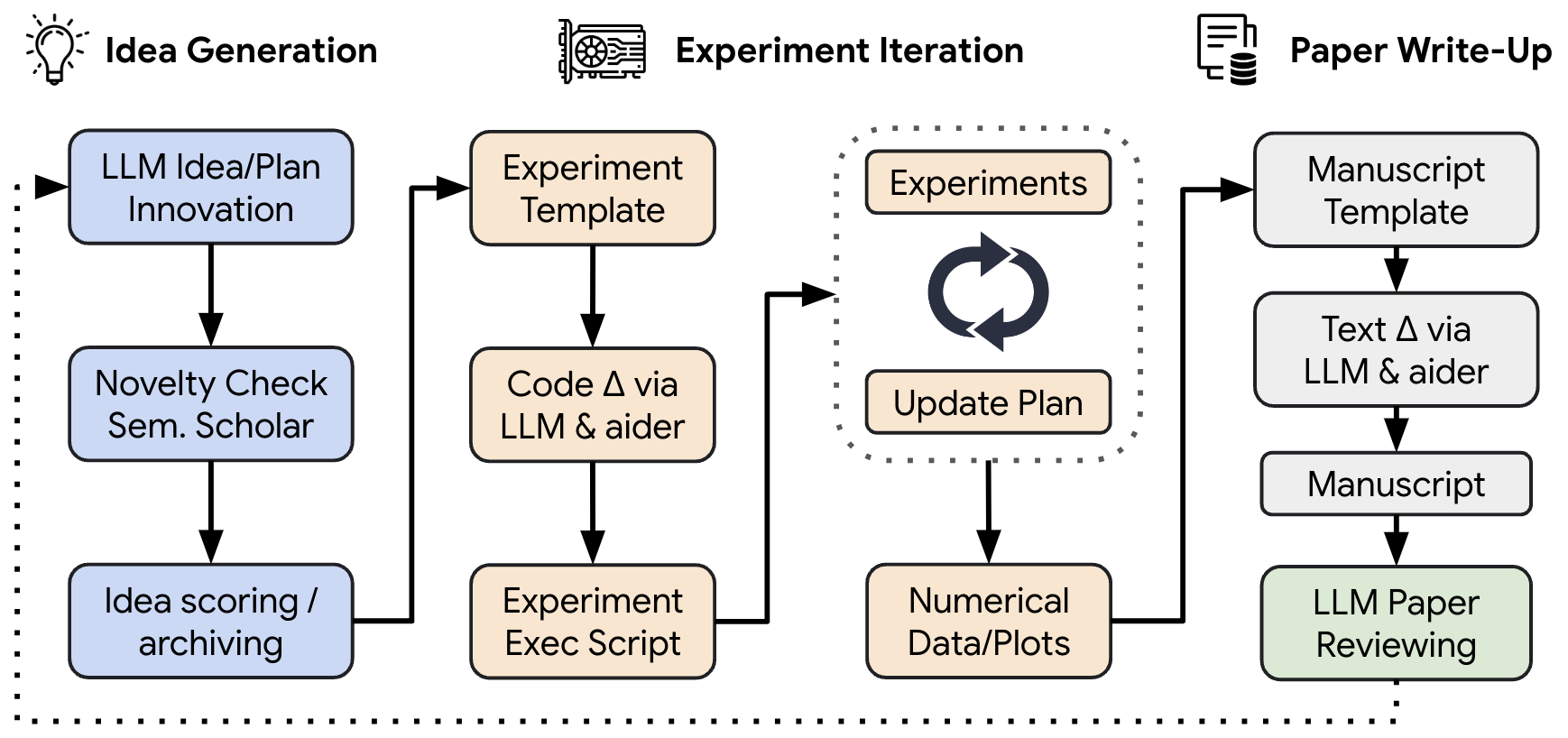
A historic turning point has arrived where artificial intelligence transcends the boundaries of simple conversational chatbots and coding assistants to become a genuine agent of scientific discovery. Developed through close collaboration between Sakana AI and researchers at the University of Oxford and the University of British Columbia, The AI Scientist (Sakana AI) is the world's first comprehensive open-source system capable of fully automating the entire scientific research process. Powered by the robust reasoning and generation capabilities of large language models, this system independently executes the entire research lifecycle, from brainstorming original research ideas and writing experimental code to collecting data, analyzing results, and ultimately formatting academic papers. The emergence of this innovative agent, which validates hypotheses and extracts meaningful conclusions across machine learning, natural language processing, and various scientific domains, delivers a massive shock and unveils new possibilities for the global academic and industrial R&D ecosystems.
Traditional applications of artificial intelligence have largely remained confined to auxiliary roles such as completing limited blocks of code or fixing bugs under the direct guidance of human researchers. This paradigm forced numerous doctoral-level professionals to expend immense time and effort on repetitive experimental designs and simulation loops, while facing physical limitations in deeply exploring complex multidimensional correlations. However, The AI Scientist (Sakana AI) effortlessly overcomes these human-centric constraints by autonomously exploring vast academic literature and operating automated feedback loops to continuously improve research quality. Through a multi-agent collaboration structure where errors trigger self-correction and iterative re-experimentation, it perfectly controls subtle variables that humans might overlook, establishing a next-generation workflow that dramatically elevates research productivity and reliability.
This innovative fully automated research system delivers immense financial value and strategic advantage across businesses and industrial sectors. First, in terms of autonomous monetization, the system accelerates the speed at which companies secure new intellectual property rights and launch innovative products in pharmaceuticals, advanced materials, and foundational AI research markets, generating an estimated 42 million dollars annually in new research service and IP licensing revenues. The ability of AI agents to formulate hypotheses on their own and draft papers at scale far surpasses the output of traditional human-led laboratories, maximizing market preemptive advantages. Of course, to fully maximize monetization, subsequent measures must follow, such as clearly establishing legal ownership and licensing policies for auto-generated papers and patents, and refining B2B SaaS subscription model packages tailored for corporate research institutes.
Second, regarding operational cost reduction, the system drastically lowers the recurring expenses of advanced R&D organizations—specifically the costs associated with repetitive experimental design, coding, and data analysis conducted by senior researchers—yielding approximately 35 million dollars in direct annual operating cost savings. Because the agent handles hypothesis validation and simulation processes in mere hours that would otherwise require dozens of specialists months to complete, astronomical wastes of labor costs and computing resources are drastically curtailed. In particular, reducing the time and money spent on repetitive failed experiments close to zero significantly contributes to a company's financial health. However, to optimize the excessive LLM API call costs and high-performance GPU infrastructure maintenance expenses incurred during system operation, strategic enhancements such as adopting lightweight proprietary models and building on-premises hybrid architectures are required.
Third, concerning the 10x productivity revolution, the platform provides a phenomenal workflow that automates the entire journey from generating research ideas to academic paper formatting, multiplying existing research velocity by over 15 times. Within the multi-agent structure, agents cross-validate one another to correct errors and simultaneously test thousands of hypotheses that would be nearly impossible for human researchers to pursue in parallel. This drastically shortens the timeline for foundational scientific discoveries that previously took years down to mere weeks, exponentially accelerating our approach toward complex scientific challenges. In the future, further strengthening real-time synchronization of recent papers via web search and integration with domain-specific simulators will make a flawless tenfold productivity leap a tangible reality.
Finally, from the perspective of search and AI visibility optimization, Sakana AI's strategy of organically linking its official announcement page and open-source GitHub ecosystem drives explosive traffic and search indexing among developers and academic researchers worldwide. Essential keywords are intricately embedded in technical documentation and benchmark reports, ensuring top-tier recommendation visibility even within next-generation agent-based search engines. Featuring deep technical moats and original architectures, The AI Scientist (Sakana AI) stands far beyond a passing trend as a hyper-competitive strategic asset destined to completely reorganize the global scientific research paradigm. Become a pioneer of innovation today by experiencing this remarkable autonomous agent directly through the link
https://sakana.ai/ai-scientist/ and take your first step toward the future.