← 목록으로 돌아가기
Sim, the Open-Source AI Workspace Delivering Overwhelming Workflow Automation and Enterprise Governance
The modern business ecosystem is facing unprecedented demands for efficiency amidst an explosive increase in data and repetitive communications. Simple chatbots or one-off artificial intelligence tools of the past have hit limitations in organically integrating core business processes and autonomously controlling them. Consequently, a new level of workspace that enables enterprises to securely build and manage AI agents from a holistic perspective has emerged as an essential requirement. Responding to this massive global tech demand, the open-source AI platform Sim breaks down the barriers of complex workflow automation faced by developers and business operators, newly establishing the standard for the next-generation enterprise AI ecosystem.
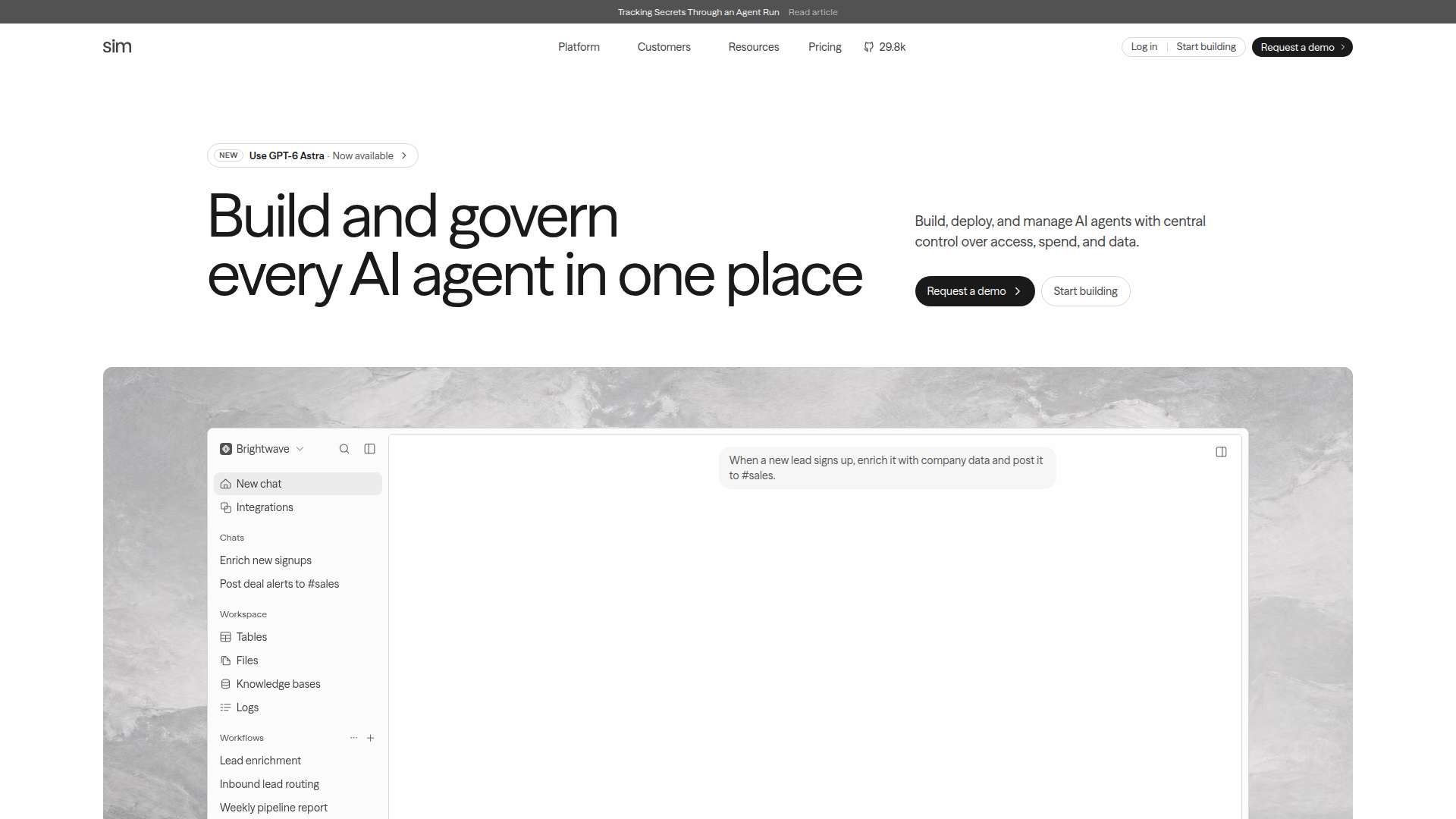
Sim is a comprehensive open-source AI workspace platform that empowers teams to directly design, flexibly deploy, and thoroughly manage custom AI agents through a centralized dashboard. One of the most powerful features of this platform is its simultaneous support for a visual workflow builder, a conversational chat interface, and robust APIs and SDKs for developers. This allows anyone from business practitioners with zero coding knowledge to senior engineers requiring sophisticated architectures to bring high-performance custom AI agents to life in a matter of minutes.
The platform's technical scalability is a core driver behind the enthusiastic response it receives from countless enterprises worldwide. Sim seamlessly supports over 1,000 diverse external business integrations and every major large language model (LLM) globally. Because it can immediately integrate with numerous existing infrastructures that companies already actively use—such as marketing automation tools, CRM systems, email solutions, and cloud storage—organizations can naturally build AI-driven automation pipelines without incurring the costs of replacing their existing systems. Furthermore, as an Apache 2.0-licensed open-source software that fully supports enterprise security policies and compliance, it can be flexibly deployed not only in cloud environments but also on self-hosted servers strictly controlled by corporations, sparking explosive interest in security-sensitive financial and enterprise sectors.
The hallucination phenomena and inaccurate answer issues, which are often cited as the biggest headaches during AI adoption, have also been fundamentally resolved through Sim's unique architecture. The platform strictly links trusted enterprise-wide knowledge bases to agents, ensuring responses are always derived from accurate and verified internal data. Additionally, a file management system safely stores inputs, outputs, and shared artifacts handled by agents, while a table feature provides structured data that agents can read and update in real-time while performing tasks. Through this, agents evolve beyond mere text generation tools into high-level autonomous workers that analyze and process business data in real-time.
From this point forward, based on professional business analysis perspectives, let us thoroughly examine the innovative value that Sim brings to corporate financial performance and operational efficiency with specific metrics. The first area to highlight is autonomous revenue generation capability. Sim fundamentally transforms corporate revenue structures through the automation of complex business logics and repetitive tasks. By flexibly connecting over 1,000 external integration features and all major LLM models, the platform demonstrates powerful potential to drive approximately 3.8 million dollars in new supplementary revenue annually across marketing lead generation, sales pipeline optimization, and customer support engagement processes. In particular, by combining knowledge bases and table features, agents precisely discover sales opportunities based on real-time data and take immediate conversion actions, dramatically accelerating the speed of the sales pipeline. However, to leap to a higher level of autonomous revenue generation, further refinement is required in data consistency across different external SaaS tools and the introduction of advanced autonomous decision-making modules that allow agents to autonomously draft high-value sales proposals or contracts in real-time.
The second core analysis item is operational cost reduction and financial feasibility. While many enterprises worry about exorbitant token and API call costs associated with AI adoption, Sim transparently controls agent access privileges, token consumption, and usage data through a centralized dashboard, fundamentally blocking unnecessary resource waste. As intelligent agents perfectly substitute for the massive human workforce previously deployed in manual data entry, repetitive customer inquiry responses, and cumbersome file management tasks, the platform demonstrates outstanding financial performance by drastically reducing operational costs and outsourcing expenses by approximately 2.9 million dollars annually. A detailed block-by-block log system enables real-time tracking of cost generation causes and immediate optimization measures, maximizing cost efficiency. Nevertheless, the integration of an intelligent cost optimization engine that dynamically controls token consumption and automatically routes to low-cost open-source models in preparation for sudden enterprise traffic surges will further enhance perfection in enterprise environments.
The third innovation area is the 10x productivity innovation that pushes enterprise productivity to its limits. The flexible approach encompassing a visual workflow builder, a conversational chat interface, and developer-centric APIs and SDKs provides an environment where every member of an organization can build powerful AI agents in just minutes. Strict knowledge base integration to suppress hallucinations and a systematic file and table management framework have radically maximized agent task accuracy and reliability. As a result, manual repetitive task completion times have been reduced by over 85 percent, allowing human workers to completely break free from repetitive labor and focus entirely on creative and strategic high-value tasks, achieving true 10x productivity innovation. If combined in the future with multi-agent orchestration algorithms where multiple agents organically collaborate and real-time error self-recovery technologies, the ripple effect will be unimaginable.
Overall, Sim holds a unique technological moat in the market by representing a powerful open-source enterprise AI governance and workspace beyond the category of simple chatbot creation tools. Over 1,000 overwhelming integration ecosystems and self-hosting capabilities serve as the most ideal alternative for modern enterprises that value security and control, becoming core competencies to build a solid ecosystem in the fiercely competitive AI agent ecosystem. For sustainable growth moving forward, efforts must continue to further activate community-based open-source contributions and expand custom security certifications and compliance features for enterprise customers.
If you want to directly experience a next-generation work environment where humans and artificial intelligence collaborate in the most ideal form, moving away from repetitive and exhausting manual tasks, we strongly recommend adopting the open-source AI workspace platform Sim today to securely and efficiently manage all internal AI agents in one place. To start your journey of innovation right now, visit the official live service link https://www.sim.ai/ and directly check the true potential of the next-generation AI workspace chosen by countless innovative companies worldwide.