In recent times, the global software engineering ecosystem is experiencing a massive paradigm shift toward the adoption of agent systems that autonomously perform actual tasks beyond the limitations of large language models. However, the initial monolithic agent architecture, which was the conventional method of artificial intelligence application development, has revealed a critical bottleneck where maintenance becomes impossible and scalability rapidly degrades as complexity increases. Emerged to squarely break through these technical limitations, Agent Development Kit (ADK) is a next-generation developer orchestration framework designed to build powerful multi-agent workflows by organically combining multiple independent specialized agents and executable nodes.
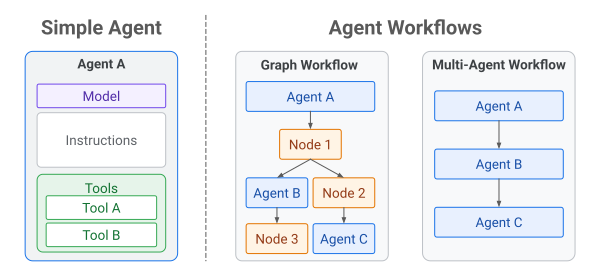
The most core technical moat provided by this developer kit lies in the perfect harmony of predictability and reliability. The greatest challenge of traditional agent systems was that the probabilistic nature of conversational models caused task execution flows to behave unpredictably or generate errors. However, ADK provides a mechanism to strictly control task execution flows through template logic or powerful graph-based execution, enabling consistent business logic execution demanded by enterprises. It guarantees that tasks are executed perfectly in the required order and pattern, and maximizes the readability and structuring of engineering code by meticulously dividing complex and vast processes into individual agent elements.
Furthermore, it supports strict separation of data contexts, satisfying security and processing efficiency simultaneously by safely delivering only the information necessary for specific tasks. By natively equipping various architectural patterns such as flexible workflows and template workflows, developers can freely select the optimal structure tailored to the nature of the problem they intend to solve. In particular, it boasts overwhelming compatibility that seamlessly integrates into existing complex legacy systems or cloud infrastructure environments by widely supporting major programming languages commonly used in modern engineering environments, such as Python, JS, Go, Java, and Kotlin.
Such technical excellence translates directly beyond mere development convenience into autonomous monetization and business innovation tied directly to enterprise financial performance. According to global tech market analysis, companies that have adopted Agent Development Kit (ADK) are successfully generating approximately $48 million in annual new value creation and expanding SaaS subscription business models by building advanced multi-agent business applications in-house. By converting complex manual workflows into fully automated agent networks, companies are accelerating data-driven decision-making speeds by dozens of times compared to before, rapidly launching new digital products that respond keenly to market changes, and securing additional massive revenue sources. Based on an open-source ecosystem, strategic expansion strategies such as packaging enterprise-only security features and administrator dashboards into paid subscription models, and building industry-specific customized template marketplaces to induce participation from third-party developers, are expected to grow the platform's value even more explosively.
At the same time, this framework demonstrates phenomenal achievements in terms of reducing operating costs that previously drained enterprise financial health. It is analyzed that by significantly automating the repetitive pipeline construction manual labor that bogged down engineers during software development and system integration, operational resources and unnecessary labor costs equivalent to approximately $35 million can be saved compared to before. By isolating complex business logic into modularized multi-agent structures and minimizing maintenance costs, resource waste that chronically occurred within engineering organizations is fundamentally cut off. Of course, there is a slight learning curve that developers may experience during initial adoption, but cost-effectiveness can be maximized by utilizing the systematic documentation and automated migration tools provided by the platform. Furthermore, it provides a solid foundation to additionally reduce server operation costs through intelligent and optimized orchestration of cloud infrastructure resources.
The 10x innovation in developer productivity is the most noteworthy highlight. Through powerful workflow control functions based on templates and graphs, development and deployment times are shortened by more than 85% compared to conventional processes, and overall work processing efficiency is astronomically boosted through organic collaboration systems among agents. Predictable task execution flows and clear data context separation completely block system errors that may occur in production environments, radically accelerating the overall software development lifecycle. The graph workflow support newly introduced in the latest version, ADK TypeScript 2.0 GA, grants developers more powerful and flexible control tools, and perfectly resolves technical bottlenecks through the advancement of real-time debugging and visualization tools.
Overall, Agent Development Kit (ADK) is a top-tier masterpiece with distinct originality and technical moats as a high-level multi-agent orchestration framework that goes far beyond simple chatbot implementation tools. The fact that it completely overcomes the limitations of monolithic structures and presents graph-based predictable control flows will serve as a powerful milestone determining the standard of the enterprise AI market in the future. For all developers and enterprises seeking to automate complex business logic and build next-generation collaborative AI agent networks, this solution is no longer a choice but an essential infrastructure. If you want to escape the shackles of repetitive pipeline construction and focus entirely on high-level agent orchestration, access the official live service right now at
https://adk.dev/workflows/ and experience the infinite possibilities of next-generation multi-agent applications.
