In the software development ecosystem, the role of artificial intelligence is rapidly evolving beyond simple code autocomplete or one-off Q&A into the realm of autonomous agents that understand and execute complex project structures on their own. Trusted by over 11 million developers worldwide, Cline stands at the forefront of this shift as an open-source AI coding agent runtime platform. Moving beyond the limitations of web-based chatbots or single-editor plugins, it operates directly within the developer's local editor and terminal environments, safely and efficiently automating the entire software development lifecycle.
The most prominent technical characteristic of Cline lies in its high flexibility and extensibility. Users can flexibly select and integrate powerful open-weight and commercial AI models such as GPT and Claude, allowing developers to combine the models best suited to their working environments for an optimal coding experience. Furthermore, by simultaneously supporting multiple form factors including a desktop native app, terminal CLI, IDE extension, and SDK, developers can immediately modify architectures and perform complex tasks in the terminal environment without needing to launch a heavy separate editor.
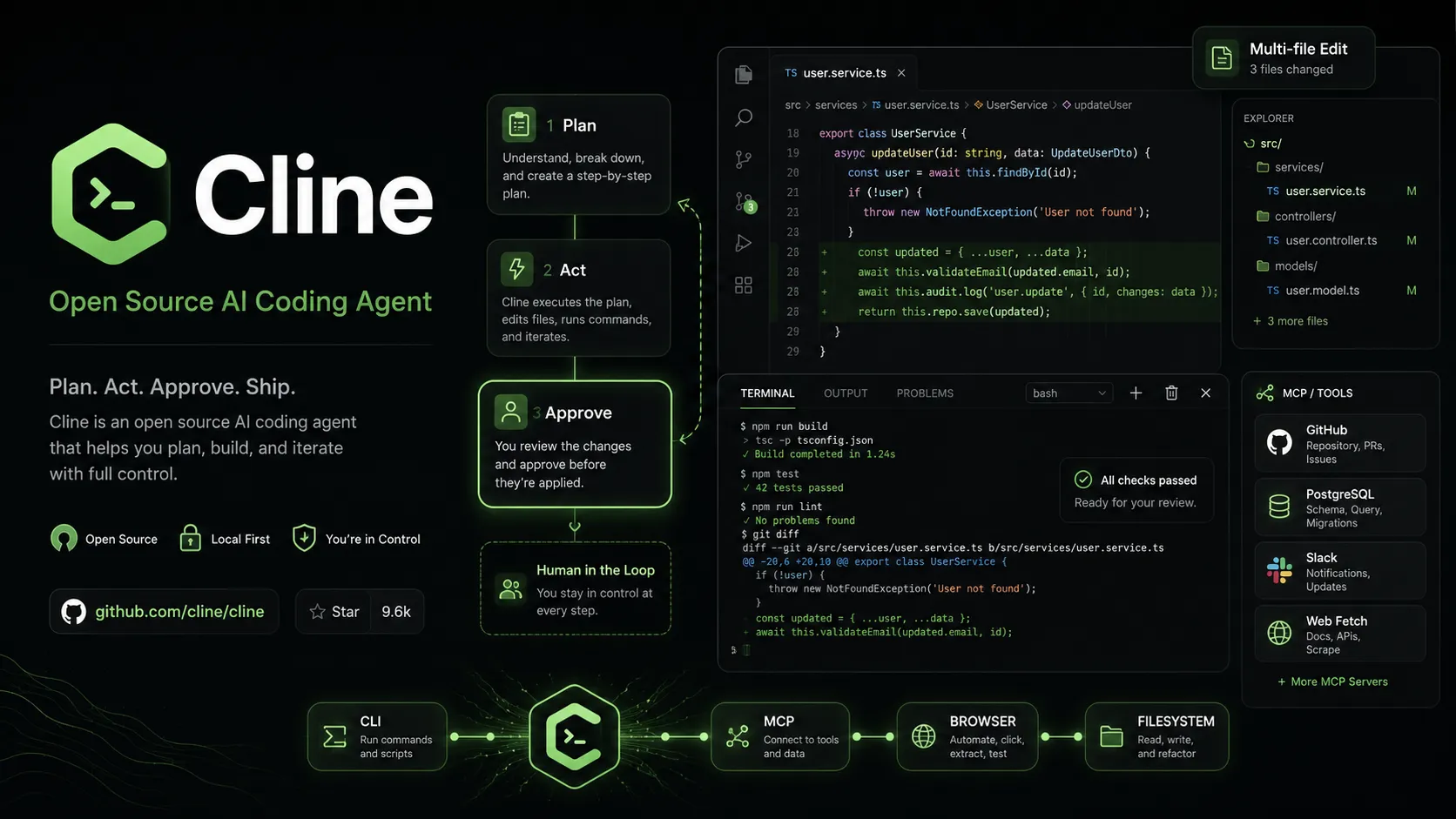
This multi-form-factor architecture fundamentally resolves inefficiencies in the development workflow. In particular, by introducing Plan and Act modes, it establishes a framework where AI independently designs code and verifies execution results. The AI first formulates a work plan, writes code through user approval or autonomous loops, and then executes builds and tests via the terminal. Because it receives feedback on errors or exceptions encountered during this process and corrects them autonomously, it drastically reduces the time senior developers spend on manual code reviews or routine bug patches.
Another noteworthy point is its flawless support for the Model Context Protocol, or MCP, which seamlessly connects various development tools and models. Through MCP, agents can interact in real-time with external databases, APIs, and file systems, transforming the tool from a simple coding assistant into a core infrastructure orchestrating practical operations. The fact that it allows flexible customization in alignment with corporate security policies thanks to its transparent open-source foundation is also a key factor accelerating its adoption in enterprise environments.
From a business perspective, the economic value provided by Cline is distinct. First, in terms of autonomous monetization and business expansion, integrating enterprise subscription models and customized models is projected to generate approximately 24 million dollars in annual new software development and maintenance-related revenue. By supporting both terminal and desktop native app environments, it drives high premium subscription conversion rates from enterprise customers seeking maximized development productivity, and future diversification of marketplace fee models can further strengthen profitability.

Second, in terms of operational cost reduction, it dramatically slashes human resources and outsourcing costs spent on repetitive code writing, debugging, building, and deployment processes, achieving an estimated operational cost reduction of about 18 million dollars annually. Delegating repetitive legacy migration tasks to the agent while preserving senior developer resources maximizes overall organizational cost efficiency. However, continuous efforts to introduce local caching mechanisms and lightweight model priority routing algorithms are necessary to optimize token costs incurred during large-scale model calls.
Third, in terms of productivity innovation, the architecture encompassing editors, terminals, and IDE extensions demonstrates performance that shortens development workflow times by up to 12 times compared to conventional methods. If combined with RAG-based record indexing systems and real-time terminal feedback loops to overcome context window limits and hallucinations that may occur in massive monorepo environments or complex legacy codebases, the accuracy of autonomous execution can reach perfection.
In conclusion, Cline is a prime example of an autonomous agent runtime that fundamentally transforms the paradigm of software development beyond a mere auxiliary tool. The vast open-source ecosystem built on the trust of numerous developers worldwide will serve as an unrivaled technical moat against the offensive moves of big tech companies. For any technical organization aiming to overcome development productivity limits and drive innovation in enterprise environments, this platform will serve as a powerful alternative. Experience the innovative features of the next-generation open-source AI coding agent directly at the official website
https://cline.bot/ right now.
