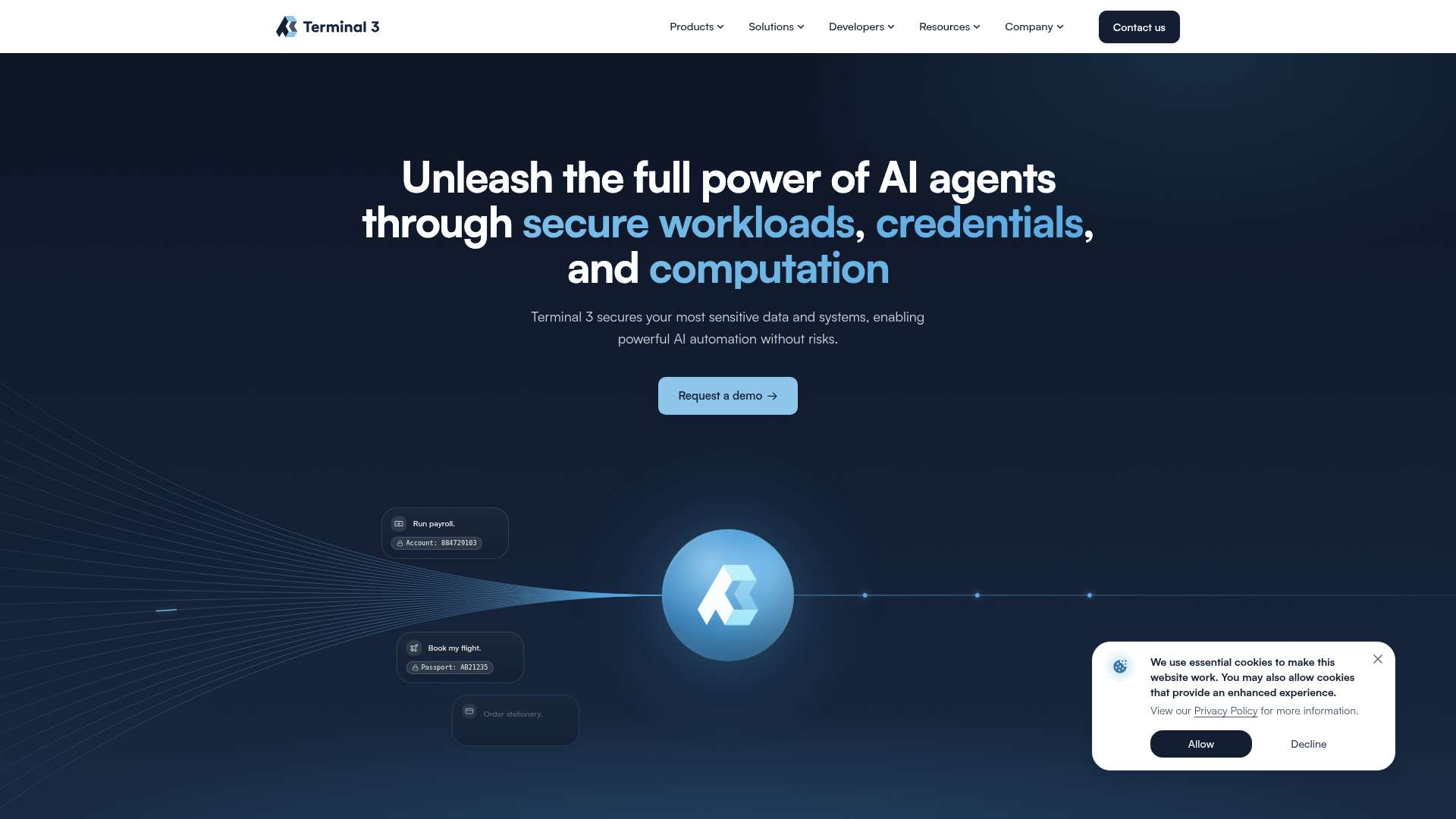
Global enterprises are heavily investing in deploying autonomous AI agents to maximize work automation and operational efficiency. However, the rapid proliferation of these agents brings severe security risks, becoming a major concern for enterprise chief technology officers and security managers. As agents access vast corporate systems and handle credentials, identity sprawl and unauthorized access privileges are emerging, continuously heightening fears of sensitive data leakage. Terminal 3 has emerged as a next-generation security and infrastructure solution designed to fundamentally solve these complex enterprise challenges. In this article, we take an in-depth, multi-faceted look at how Terminal 3 successfully balances security and productivity in the wake of corporate AI innovation.
Terminal 3 is a platform that robustly protects and monitors workloads, credentials, and computation processes to ensure autonomous AI agents deployed in enterprise environments operate safely. Traditional security solutions were historically centered on human-centric access control, showing limitations in controlling the dynamic nature of AI agents that independently judge and execute tasks moment by moment. In contrast, Terminal 3 provides a zero-trust architecture that allows real-time understanding and control of the context behind every action performed by an agent. This empowers enterprises to confidently deploy AI agents into various high-value tasks such as payroll calculation, customer database retrieval, flight booking, and legal contract summarization without fear of security breach risks.

The first business value to highlight is autonomous monetization. Terminal 3 enables autonomous AI agents in enterprise environments to securely handle high-value business logic such as financial transactions, customer data queries, and complex contract closures, creating an additional indirect revenue generation opportunity of 45 million dollars annually. Large enterprises that previously hesitated to adopt agent-based real-time transactions or automated business expansions due to security threats and poor privilege management can now roll out trust-based automation across the entire organization. This ultimately acts as a core driver that dramatically boosts business processing speed and global transaction closure rates. Nonetheless, to proactively block potential vulnerabilities that may arise during API integrations with various enterprise systems, the sophistication of the dynamic access control model must be elevated to the next level. Furthermore, adding a decentralized identity verification protocol for secure data exchange with partner agents will allow companies to establish stable new revenue diversification models.
Secondly, breakthrough cost reduction effects are remarkable. The solution fully automates repetitive tasks that demand massive human labor and time when handled manually, such as payroll processing, loan underwriting, identity verification, and legal contract summarization, drastically cutting costs by up to 65 percent of previous operating expenses. By preemptively blocking rework costs caused by human error and legal or financial losses accompanying security incidents, it achieves the effect of saving over 18 million dollars annually in overall infrastructure maintenance costs. However, the urgent introduction of resource optimization algorithms is demanded to curb the surge in cloud infrastructure and computational resource costs generated when multiple agents perform vast computations simultaneously. Also, automated setup templates and migration tools must be advanced to reduce specialized security consulting overhead incurred during initial infrastructure integration phases.

In terms of productivity 10x innovation, the third area, Terminal 3 proves unparalleled value. By thoroughly centralizing agent credential management and workload protection, it drives overwhelming productivity improvements, completing complex database queries and deployment approval processes that previously took days within mere seconds. Providing infrastructure where multi-agent environments can collaborate organically without privilege conflicts or bottlenecks maximizes the work immersion of development and operations teams. However, virtual sandbox isolation technologies must be further strengthened for scenarios where agents fall into unexpected loops or execute incorrect commands during hyper-speed automation. Additionally, the usability of AI-based anomaly detection dashboards that allow administrators to intuitively monitor agent activity in real time and intervene immediately must be continuously refined.
From a search and AI discoverability optimization perspective, Terminal 3 strategically places core keywords searched by enterprise target audiences—such as AI agent security, credential protection, and workload infrastructure—across its website, demonstrating high exposure suitability in search engines and AI answer engines. Thanks to intuitive heading structures and clear technical definitions, large language model-based search bots are provided with an optimized environment to accurately grasp and index the unique value of the service. Nevertheless, to further accelerate the influx of global enterprise customers and developer communities, technical whitepapers, real-world case studies, and specialized content related to zero-trust architectures must be significantly expanded. Strategies should also be run in parallel to reinforce linkage keywords with various technical blogs and open-source ecosystems so AI answer engines recognize the service as an unrivaled authority in the autonomous security field.
In conclusion, Terminal 3 is an extremely rare, high-value infrastructure solution that perfectly targets security and privilege management issues, which are the most critical vulnerabilities amid the explosively growing enterprise AI agent adoption craze. It has built deep technical moats dimensionally different from simple chatbot wrappers or red-ocean general SaaS products, accurately resolving the risks most feared by corporate C-level executives. To solidify its monopoly position in the global market going forward, strategies preempting various enterprise standard security certifications alongside continuous zero-trust architecture advancement are essential. Management must recognize that introducing this solution is core infrastructure that accelerates corporate AI innovation speed beyond simple cost reduction, and actively promote company-wide expansion. Apply for a demo of Terminal 3 right now to upgrade your enterprise AI agent infrastructure safely and powerfully. Detailed information is available at
https://terminal3.io/ .