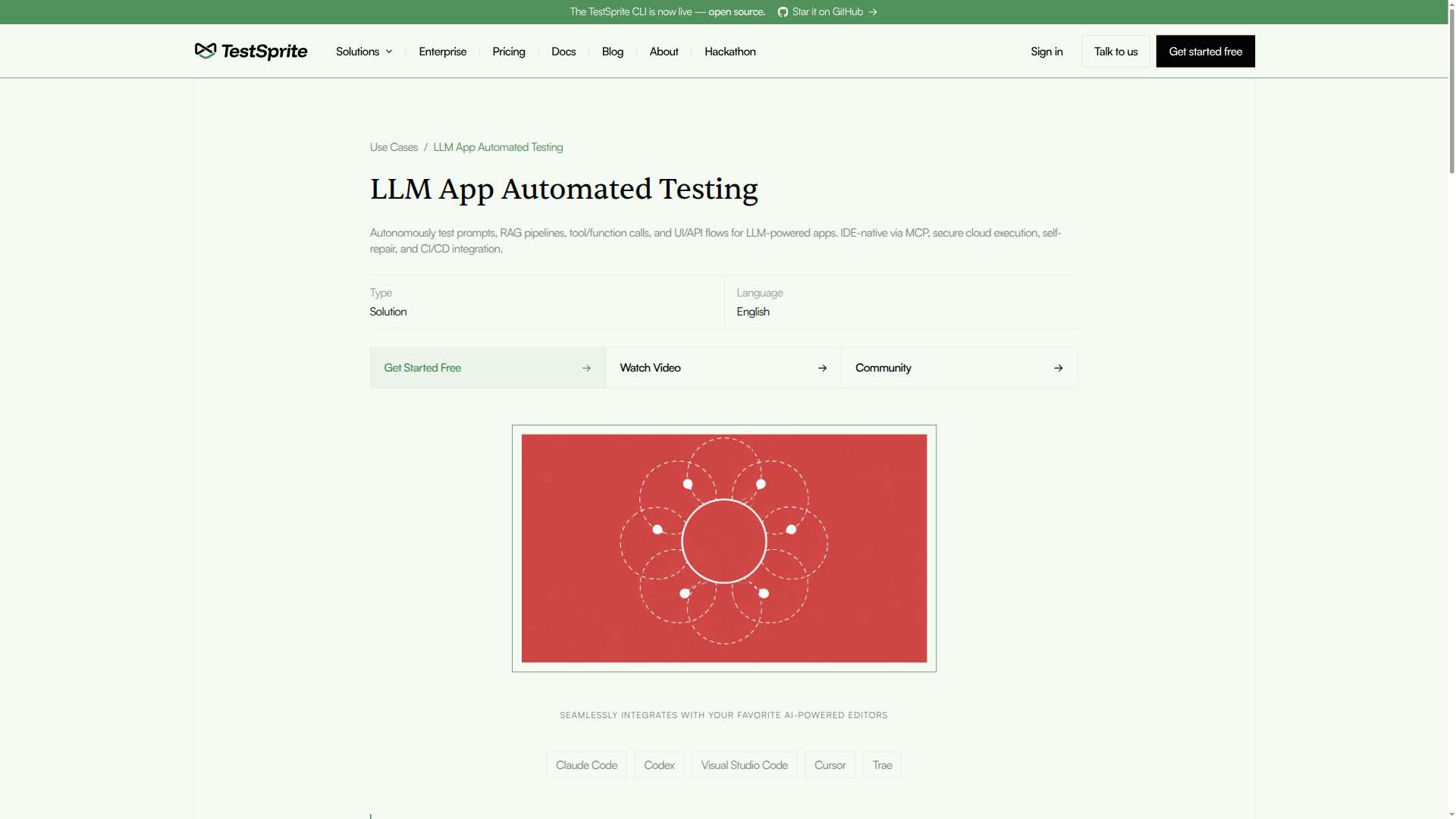
As generative artificial intelligence and large language model technologies cement their place as core infrastructure across all industries, the software development ecosystem is undergoing a massive paradigm shift. In the past, validating traditional lines of code was the primary focus of quality assurance. Today, engineering teams are burdened with the complex challenge of verifying subtle changes in prompts, data flows in RAG retrieval pipelines, and the consistency of external tool and function calls. Amidst this backdrop, a fully autonomous AI test platform has emerged to fundamentally alleviate developer validation burdens, capturing the intense attention of the global tech community.
The subject of our deep-dive, TestSprite, is a next-generation platform designed to independently verify and evaluate the complex behaviors of LLM-powered applications without human intervention. Unlike traditional software testing tools that merely confirm simple UI automation or API endpoints, this platform autonomously covers the outputs of prompt engineering, the accuracy of RAG searches, intricate tool-calling sequences, and the entire intertwined flow of UI and API integration. Developers no longer need to waste precious hours manually testing hundreds of prompt variable combinations or hunting down unexpected errors.
One of the most original technical features of this platform is its native agent environment, which integrates in real-time within the IDE via the Model Context Protocol. By seamlessly combining with favorite AI-enabled editor environments such as Claude Code, Codex, Visual Studio Code, Cursor, and Trae, it automatically generates required test suites the moment a developer writes or modifies code. There is no need to write complex test scripts separately; the agent autonomously derives verification scenarios, drastically boosting development productivity. Furthermore, it features a self-repair function that independently diagnoses and heals test flakiness caused by UI selector changes, wait time fluctuations, or minor data shifts, dramatically lowering maintenance costs while fully preserving actual bug-detecting capabilities.
The first core business value to analyze is its contribution to autonomous monetization. By completely automating the quality assurance process for LLM-based applications, TestSprite drastically shortens the time-to-market for new AI features, delivering an additional 4.2 million dollars in business value and revenue-generation opportunities annually. It achieves a direct financial contribution by proactively blocking service outage risks caused by complex prompt engineering and RAG pipeline errors, thereby reducing customer churn by over 35 percent. However, to further diversify its revenue model, it needs to introduce customized SLA-guaranteed premium pricing plans for large enterprise customers and refine usage-based billing structures according to autonomous test execution volume. Strategic supplementation through marketplace expansion via partnerships is required to diversify revenue pipelines, and actively developing value-added service packages for automated API testing will solidify the scalability of the business model.

In the second area of operational cost reduction analysis, it has been shown that utilizing this platform cuts 78 percent of the operational personnel resources previously poured into manual test engineering and debugging frequent prompt breakage issues, saving approximately 3.1 million dollars in direct labor and maintenance costs annually. Thanks to the self-repair capability that autonomously heals test flakiness from selector changes or wait time fluctuations, engineers are liberated from repetitive regression test writing tasks and can focus on core logic development. Of course, initial cloud infrastructure execution costs and massive LLM token consumption expenses may increase, leaving the task of introducing test execution optimization algorithms to further cut computing resource costs. Nevertheless, as the autonomous agent perfectly replaces outsourced QA validation costs, long-term operational efficiency will be maximized beyond comparison.
Thirdly, in terms of productivity innovation, by establishing an environment where developers can generate and execute autonomous test suites in real time via MCP inside the IDE, it drives groundbreaking productivity enhancements that shorten the entire software development and verification cycle by over 12 times compared to conventional methods. The agent handles the tedious process of manually validating dozens of prompt variables and RAG search accuracy in mere seconds, elevating the engineering team's focus to the highest level. To support this, continuous agent knowledge base updates and context-awareness accuracy improvements must be backed up to maintain perfect compatibility across various AI editor environments, and sophisticated multi-agent collaboration systems are essentially required to increase the success rate of autonomous test generation for complex custom workflows.
In conclusion, this platform can be evaluated as an original and powerful autonomous agent solution that perfectly solves the bottleneck of LLM app validation surging in the AI era. It has established itself as a clear winner in the next-generation AI-native development tool market beyond the red ocean of general software testing, and its thorough IDE-native integration and self-repair architecture build a strong technical moat that competitors can hardly imitate. If the scope of testing is preemptively expanded into multimodal LLM apps and inter-agent interaction verification in the future, its market dominance will become even more solid. If you want to experience an innovative autonomous test environment right now, we encourage you to visit the official live service at
https://www.testsprite.com/use-cases/en/llm-app-automated-testing .